EPDM Roofing in Falls Church, VA
The City's Building Safety Division prints the weather its buildings are designed for on a single sheet. Two of its numbers bear on a flat roof, snow and wind. Neither one names a roofing material, so this page reads them for an EPDM roof and says where the sheet stops.
The sheet applies to every roof and names no membrane. Use it to start a talk about drains, edges and the structure, not as an EPDM rule.
- Ground snow load: 25 psf
- Ultimate wind: 104, 112 or 119 mph by risk category
- Winter design temperature: 17°F
The sheet
What does the City of Falls Church print as its roof design numbers?
The sheet is headed Codes and Standards and lists the 2021 Virginia code editions the City works from, then a table called Local Climactic and Geographic Design Criteria. It carries no date. We opened it on October 12, 2026 and read the wind rows from the rendered page, because the text version scrambles the columns.
-
25 psf of snow on the ground
- The sheet says
- Ground snow load, 25 psf, by the ASCE 7-16 standard.
- For a flat roof
- It is a ground figure. The sheet gives no roof snow load and no drift allowance, so the building's designer works those out.
- Ask
- Whether the deck was checked for snow before anyone proposes extra weight on it.
-
Ultimate wind by risk category
- The sheet says
- Category I, 104 mph. Category II and Residential, 112 mph. Category III, 119 mph.
- For a flat roof
- These feed edge and uplift design. The model building code asks that metal edge systems on low-slope membrane roofs be designed for those loads and tested to the ANSI/SPRI ES-1 standard.
- Ask
- Which category the building falls in, and for the test listing of the edge metal.
-
17°F winter, ice barrier "Yes"
- The sheet says
- Winter design temperature 17°F, and Ice Barrier Underlayment Required: Yes, with no note on which roofs.
- For a flat roof
- The model code clause on ice barriers lists shingles, slate, shakes and roll roofing, not membranes. Virginia's amended text of it is outside what we read.
- Ask
- Whether Code Administration reads the line as reaching a membrane roof.
None of this names EPDM. EPDM is the rubber single-ply sheet, usually black though also made in white, and the building code lists it under its own ASTM standard, D4637. That standard is the handle for the data sheet. The City's numbers reach an EPDM roof the way they reach any flat roof: through slope, drains, edges and the structure under it.
Snow to drain
What happens to melting snow on a flat EPDM roof?
-
First: the melt reaches the surface
The Asphalt Roofing Manufacturers Association lists melting snow and ice, rain and runoff from rooftop equipment as the ways water ends up standing on a roof.
-
Second: it needs somewhere to go
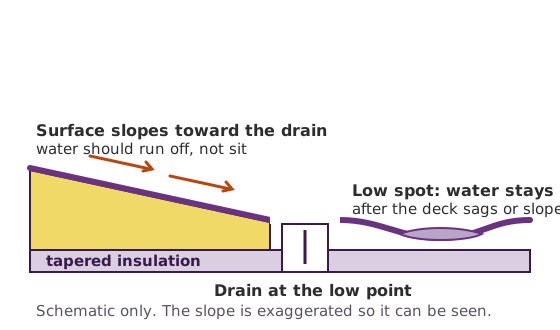
Where the deck does not slope enough, the same bulletin names tapered insulation as the way to give water a path to the drains. The diagram below shows the idea with the slope exaggerated.
-
Third: what does not drain can freeze
The bulletin says moving ice may scrub a membrane. It was written for asphalt systems and did not test EPDM, so we cite it as a drainage point only.
Stop here if water still stands after a thaw: raise slope and drains before talking about the sheet
Ultimate is not the word the state uses
Virginia's building code words its permit exemption for house re-roofing around a "nominal design wind speed" over 100 miles per hour. The City's sheet prints ultimate speeds and no nominal one. Because the sheet does not convert between them, we do not say whether Falls Church sits above or below that line. Ask Code Administration, 703-248-5080.
In writing
What should an EPDM quote for a Falls Church flat roof spell out?
- The standard on the data sheetName the membrane by its ASTM standard, D4637 for EPDM, instead of a trade name.
- How seams are made and checkedEPDM seams are joined with adhesive or tape, and NRCA's library notes that many EPDM problems have involved lap seams.
- Edge metal and uplift listingAsk for the wind test listing of the whole assembly and for edge metal tested to ANSI/SPRI ES-1.
FAQ
Questions about the City's design numbers and EPDM
Does the City's design sheet say anything about EPDM?
No. It names no roofing material. Its numbers apply to the building, and the membrane choice is a separate decision.
What does 25 psf of ground snow mean for my flat roof?
It is the figure the City prints for the ground. A roof's design load is worked out by the designer from that number and the roof's shape, and the sheet gives none. If extra weight is proposed, ask the designer.
Which of the three wind speeds applies to my building?
For a house, the sheet's own row reads Risk Category II and Residential, 112 mph. For anything else the sheet does not say which category applies, so ask the office.
Do these numbers hold for Seven Corners or Bailey's Crossroads?
The sheet is the City's. Those areas have Falls Church addresses but answer to Fairfax County, whose own design criteria are not covered here, so do not carry the numbers across the line.
Does melting snow count as ponding water?
The ARMA bulletin lists melting snow and ice among the sources of ponding, beside rain and equipment runoff.
Does the ice barrier line mean my flat roof needs one?
The sheet says only Yes, with no roof types. The model code clause we read names shingles, slate, shakes and roll roofing. Ask Code Administration how it treats a membrane roof.
Is the sheet a roof permit rule?
No. It lists design criteria. Permit thresholds sit on other City pages, summarized on our Falls Church page.
Nearby
Where else can a Falls Church owner read about flat roofs?
Start at Falls Church for the permit table. For condominium and multi-unit buildings read TPO roofs in Falls Church, or see how another Northern Virginia place handles the same membrane in EPDM roofs in Reston. The flat roof page compares the systems, and all materials and service areas are a click away.
Talk through the next step
Tell us about the flat roof and where it holds water
Give us the street address, the building type and what you see after rain or a thaw. We will say which office to ask before anyone is scheduled.
9220 Topaz St, Fairfax, VA 22031
Mon to Fri 7 AM to 8:30 PM, Sat 7 AM to 8 PM, closed Sunday