Spray Foam (SPF) Roof Coating in Northern Virginia, DC & Maryland
Seamless closed-cell SPF + protective topcoat for flat and low-slope roofs — adds R-6.5 per inch of insulation while delivering a fully bonded waterproof membrane.
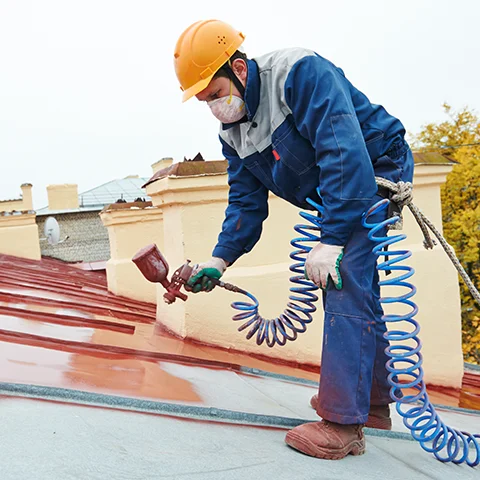
Spray Polyurethane Foam (SPF) roofing is a hybrid system: a closed-cell foam base that provides both insulation and substrate, topped with a UV-protective coating (silicone or acrylic). When installed properly, SPF eliminates seams, self-flashes at every penetration, and dramatically reduces cooling loads on flat or low-slope buildings. King's Roofing installs SPF roof systems across the DC metro on small commercial, multi-family, and complex residential applications where the seamless monolithic membrane delivers value that single-ply systems can't match.
How SPF Roofing Actually Works
Two-component closed-cell polyurethane foam is sprayed directly onto the prepared substrate (existing roof or fresh sheathing) at a typical 1.5–3 inch thickness. The foam expands to 30× its liquid volume, conforming to every surface and self-flashing around every penetration. Within minutes it cures to a closed-cell density of about 3.0 lb/cuft — strong enough to walk on with normal foot traffic.
The cured foam is then top-coated with either silicone (our default — best UV durability) or acrylic (lower cost, shorter service life). The coating is what handles the sun; the foam is what handles the insulation and waterproofing. Coatings need re-application every 10–15 years; the foam underneath, if not damaged, can last 30+ years.
When SPF Is the Right Choice
SPF excels in three scenarios. (1) Flat roofs with many penetrations — vent stacks, HVAC curbs, conduit chases — where each penetration is a potential leak path on a single-ply system. (2) Roofs over conditioned space where insulation R-value matters; SPF adds ~R-6.5 per inch with no thermal bridging through fasteners. (3) Re-cover applications over existing roofs in good structural condition but failing surface; SPF conforms to and bonds with the old substrate without tear-off.
It's less suitable for: roofs with structural movement (the foam can crack at deflection points), DIY-budget projects (proper SPF requires experienced application crews and weather windows), or homes with HOAs that require a traditional shingle aesthetic.
SPF vs Single-Ply Membrane: Cost & Performance
Installed cost for a 60-mil TPO single-ply runs roughly $9–$13 per sq ft in the DC metro. SPF at 1.5–2.0 inches with silicone topcoat runs $11–$16 per sq ft — higher upfront but with several payoff vectors: (1) reduced cooling loads (15–30% summer cooling-energy savings on a small commercial building), (2) added structural rigidity (foam adheres the deck and walls together as one diaphragm), (3) no seam failure mode (single-ply seam failure is the #1 long-term leak source on TPO/EPDM), and (4) re-coatable indefinitely — when the silicone topcoat ages out at year 12–15, a fresh coat extends the life another 15 years at maybe 25% of the original install cost.
Over a 30-year holding period, SPF often costs less per year than the cheapest single-ply alternative. We'll run the math for your specific roof at the inspection.
Installation: What to Expect on the Day
SPF requires a tight weather window: dry substrate, ambient temperature 50°F+ (or substrate temperature 50°F+ for cold-weather formulations), and wind under 12 mph (overspray drifts in higher wind and can damage neighboring property — cars, siding, landscaping).
Day 1: substrate prep and any tear-off of old loose material. Day 2: foam application — usually completes a 5,000 sq ft roof in one day with two sprayers and a helper. Day 3: silicone topcoat first pass. Day 4 (or after 24-hour cure): second silicone pass. We always do two thin coats rather than one thick one — better adhesion, better UV durability, longer service life.
Maintenance & Warranty
Our standard SPF system carries an 18-year manufacturer warranty (we use Gaco silicone topcoats from Holcim and BASF foam). With recommended biennial inspection and topcoat refresh at year 12–15, the system routinely reaches 28–35 years. We schedule the topcoat refresh proactively — it's much cheaper than allowing UV degradation to reach the foam.