Seams
Seams are the joints between sheets or strips. A seam can open from movement, age, poor welding or poor adhesion, and a small gap lets water travel under the membrane before it shows up indoors.
King's Roofing works on the low-slope roofs that sit behind townhouses, over porches and additions, and on DC row houses. For a larger or commercial roof, call and describe the building. Flat roofs fail in different places than shingle roofs, so the first job is working out which system you have and where the water gets in.
Know your roof
Most roofs called flat are really low-slope roofs: they pitch very slightly so water runs to a drain, a scupper or an edge. Which membrane covers that surface decides how it fails and how it is repaired, so identify it before you call anyone.
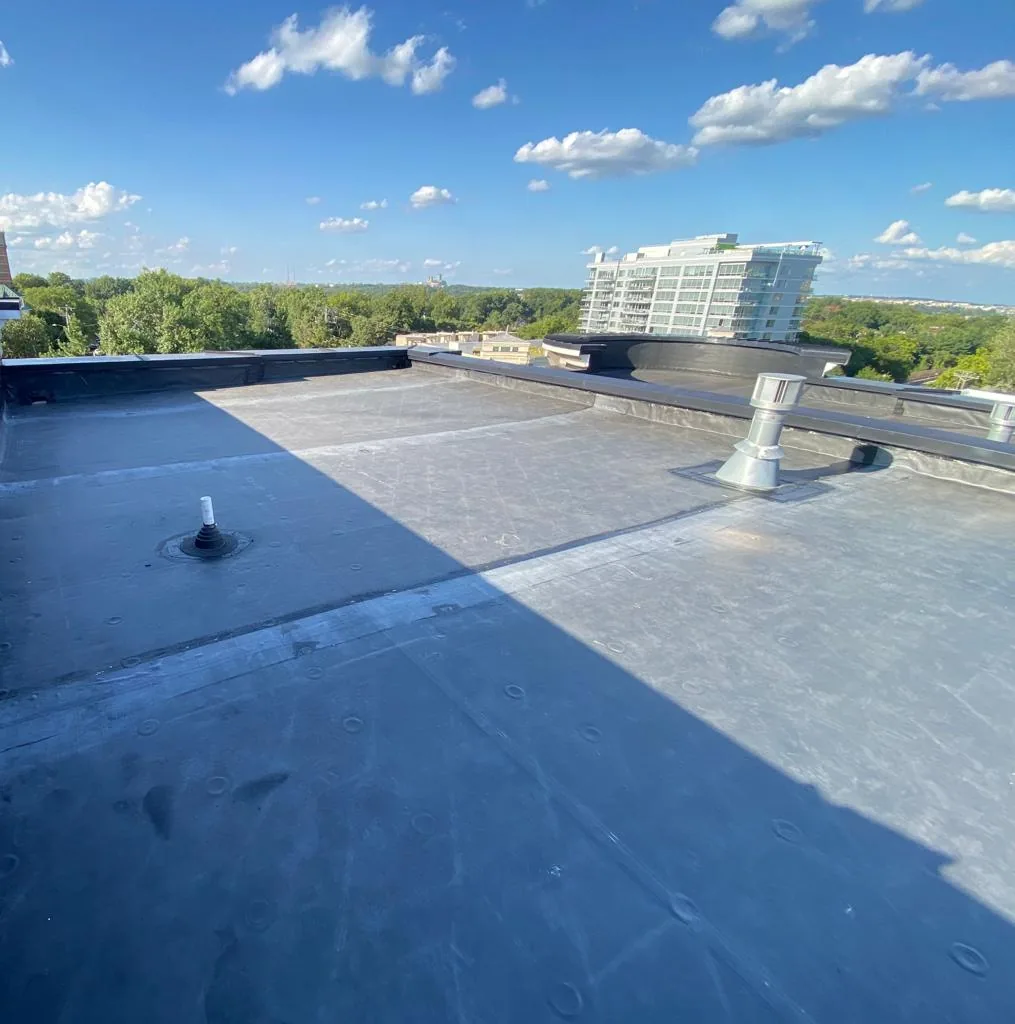
From the roof edge or a window, look at the color, the surface and the seams. A smooth white or light gray sheet with welded seams is usually TPO or PVC. A black or dark gray rubber-like sheet is usually EPDM. A rough, dark surface that looks like rolled asphalt, sometimes with fine gravel-like granules, is usually modified bitumen or an older built-up roof. A sticky silver or white painted layer on top means a coating has been applied over something else.
Identification
Treat this as a first guess. A roofer confirms it on the roof.
| System | What it usually looks like | How seams are joined |
|---|---|---|
| TPO | Smooth sheet, most often white or light gray, with a slightly dull surface | Heat-welded with hot air |
| PVC | Smooth sheet, often white or light gray, a little glossier and stiffer than TPO | Heat-welded with hot air or solvent |
| EPDM | Black or dark gray rubber sheet, matte, sometimes white on one side | Seam tape or adhesive, sometimes a glued splice strip |
| Modified bitumen | Dark asphalt-based sheets in overlapping strips, often with a granule or reflective top layer | Fused with heat, set in hot asphalt or cold adhesive, or self-adhered |
Why flat roofs leak
On a pitched roof, water leaves quickly. On a low-slope roof it moves slowly and waits at every weak point.
Seams are the joints between sheets or strips. A seam can open from movement, age, poor welding or poor adhesion, and a small gap lets water travel under the membrane before it shows up indoors.
Vent pipes, exhaust caps, rooftop units, skylights and conduit all cut through the roof. Each one has a flashing or boot that moves with the building and can crack or pull loose.
A clogged drain or scupper turns a roof into a shallow pool. The area around a drain bowl also needs careful detailing, because a small dip there holds water.
Where the roof turns up a wall or a parapet, the membrane and the flashing above it must stay sealed. Wall caps and counterflashing are a common source of leaks on attached buildings.
Water that is still standing a couple of days after rain is a warning sign. It adds weight, speeds up wear on the surface and finds any pinhole. A common rule of thumb is to look closely at water that lingers for 48 hours.
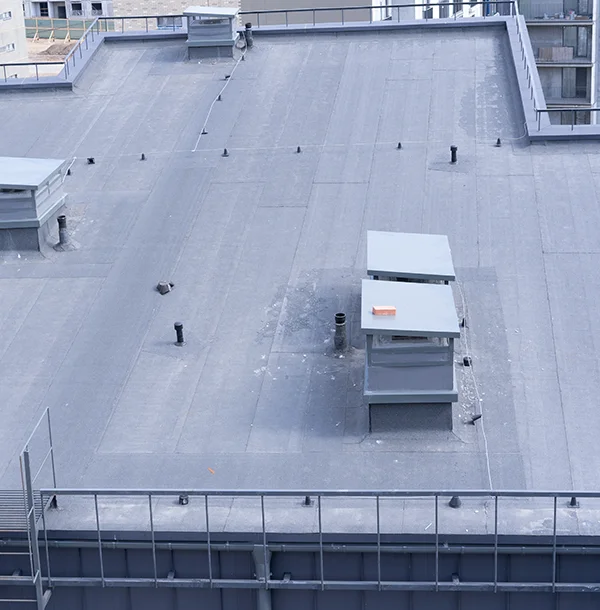
Trapped moisture can lift the surface into blisters, and foot traffic, tree branches and dropped tools can puncture it.
Signs of failure
Stay off a roof that is leaking or feels soft. Take photos from a safe spot and note when the leak shows. If a storm caused the damage, our roofing insurance page explains the next steps.
Repair
Water on a low-slope roof can run along the deck or through the insulation before it drips inside, so the stain is only a clue. The work starts with the seams, flashings, drains, penetrations and edges, then checks whether the insulation under the surface is dry.
Typical repairs are re-welding or re-taping a seam, patching a puncture, rebuilding a flashing or a pipe boot, clearing and reworking a drain area, and re-securing wall flashing. The method has to suit the membrane, because a patch that sticks to one system may not bond to another.
On the phone consultation we ask about the building, the roof age if you know it, any earlier repairs, where water shows inside and what the surface looks like.
Decide
Condition and moisture matter more than age alone.
| Situation | Usually points to | Why |
|---|---|---|
| One or two leaks at a seam, boot or flashing, insulation dry | Repair | The damage is local and the rest of the membrane is doing its job. |
| Surface worn or chalky but watertight, deck and insulation dry | Recoat or restoration | A coating can renew a sound surface, but only over a clean, dry roof with a sound surface. |
| Leaks in many places or repairs keep stacking up | Replacement | Widespread failure is cheaper to fix once than to chase repeatedly. |
| Wet insulation across a large area | Replacement of the wet sections or the whole roof | Coating over trapped moisture seals it in and the problem returns. |
| Chronic ponding from a sagging deck or poor slope | Replacement with tapered insulation or drainage changes | A new surface laid over the same low spots will pool in the same places. |
| Plans to sell, add on or install rooftop equipment soon | Ask for all three options in writing | The future use of the roof can change which option makes sense. |
Cost depends on the system, the size, the access, how much insulation is wet and what the roof edge and drains need, so we do not publish a single number. Ask for a written scope that names the area, the materials, what is excluded and how hidden damage is handled, then compare scopes before you compare totals. If the sloped part of the building needs work too, see roof replacement.
Membranes compared
General characteristics only. The manufacturer's data and the building's details decide the final choice.
| Feature | TPO | EPDM | PVC | Modified bitumen |
|---|---|---|---|---|
| Type | Single-ply thermoplastic sheet | Single-ply synthetic rubber sheet | Single-ply thermoplastic sheet | Asphalt-based sheets, often in layers |
| Seams | Heat-welded | Taped or glued | Heat-welded | Overlapped and fused or adhered |
| Surface color | Usually white or light, reflective | Usually black, absorbs heat | Usually white or light, reflective | Dark, with some light or granule-coated options |
| Ponding tolerance | Water should still drain; chronic ponding wears the surface | Handles water well when seams are sound, but ponding still shortens life | Welded seams resist water; ponding still needs correcting | Prolonged ponding can stress the surface and seams |
| Repair behavior | Patches weld on, though aged sheet can be harder to bond | Patches and tape bond to clean, dry rubber | Patches weld on; stiff sheet can crack at details | Patches are applied over clean, dry sheet; torch work needs fire precautions |
| Good fit | Large open roofs, cooling load concerns | Smaller roofs, shaded roofs, hidden roofs | Roofs exposed to cooking exhaust, oils or chemicals | Existing asphalt roofs and layered repairs |
None of these is the right answer for every building. Roof shape, number of penetrations, access, local rules and what already sits under the surface can matter more than the product label. See the TPO, EPDM and modified bitumen guide for a longer comparison, or compare every roofing material if the sloped part of your roof is also on the table.
Coatings
Sometimes. A coating renews a sound roof. It does not rescue a failed one.
A liquid applied over the existing roof that cures into a seamless, flexible layer. It is generally the coating considered where water sits for long periods, and it needs a clean surface.
A water-based coating that is usually easier to apply and often lower in cost. It generally does not suit roofs with standing water, so drainage must be sound before it is considered.
A foam sprayed to form a seamless, insulating layer, which needs a dry deck and must be protected with a topcoat, because sunlight breaks foam down.
If a coating or foam is suggested for your roof, a few questions keep the decision sound:
For a plain-language look at two common coating types, read silicone vs acrylic roof coating.
Who it suits
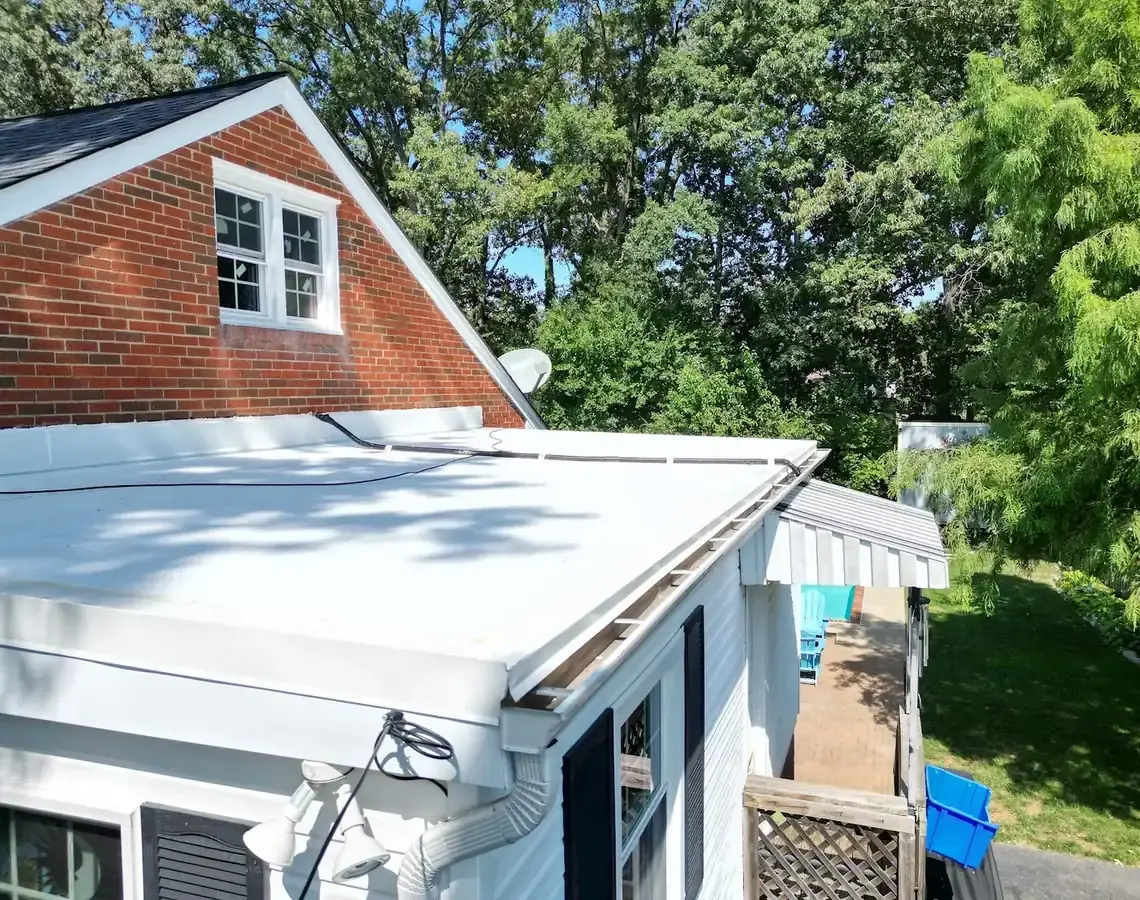
Flat roofs show up where a pitched roof does not fit the building. In Northern Virginia, the common cases are townhouse rear additions, kitchen and family room bump-outs, porch and carport roofs, garage roofs and dormer tops. DC row houses almost always have a low-slope main roof with a parapet and wall flashing. Small commercial buildings, such as offices, shops and restaurants, usually have a membrane roof with rooftop equipment.
Each type brings its own details to settle before work starts. On an attached townhouse, ask who owns and maintains the roof section and whether the association must approve a color or product. On a row house, the shared walls and wall caps decide a lot of the work.
Whether a roof job needs a permit depends on the scope and the jurisdiction, so confirm it with the local building office before a date is set. Our service areas page lists where we work, including Fairfax and Washington DC, and the flat roof repair in DC guide covers commercial roofs in the District.
Process
Five steps, each with something you can ask to see in writing.
A free 15-minute call about the building, the roof surface, the age and where water shows inside.
Someone looks at the surface, seams, drains, flashings and penetrations, and checks the ceiling or attic below where it can be reached.
The options in plain terms, repair, recoat or replace, with what each includes, what is excluded and how hidden damage would be handled.
Done to the written scope, with the work area protected and the roof left clean and with water draining.
A plain description of what was changed and what to watch, such as drains and seams, over the next seasons.
Reviews
5.0 on Google from 60 reviews.
FAQ
Repair is reasonable when the damage is local and the insulation under it is dry. Replacement fits better when leaks are widespread, repairs keep recurring or the insulation is wet over a large area. A moisture check and a look at the whole roof decide, not the age alone.
Seams, penetrations such as vents and equipment curbs, drains and scuppers, and the flashing where the roof meets a wall or parapet. Ponding areas add stress to all of them, which is why water that will not drain is worth fixing early.
TPO is a thermoplastic sheet, usually white, whose seams are heat-welded. EPDM is a synthetic rubber sheet, usually black, whose seams are taped or glued. Both are single-ply membranes, and the building, the roof shape and the details around it often matter more than the label.
Sometimes. A coating or spray foam suits a roof that is watertight, dry underneath and firmly attached. It does not suit wet insulation, a damaged deck or open seams.
It depends on the system, the size, the access and what failed. A small patch and a drain rebuild are very different jobs, so any figure given without seeing the roof is a guess.
Call (703) 712-1506 and describe the building type, how the roof is reached and what sits on it. We will tell you on the call whether it is a fit before any visit is planned.
Talk through the next step
Tell us the building type, what the roof surface looks like and where water shows up inside. A short phone call is the first step, before anyone is scheduled.
9220 Topaz St, Fairfax, VA 22031
Mon to Fri 7 AM to 8:30 PM, Sat 7 AM to 8 PM, closed Sunday