EPDM roofs in Sterling, VA and the parapet Loudoun's zoning text mentions
Most Sterling housing is houses and townhouses, so a rubber flat roof here points to a larger building: apartments, offices, warehouses. For those, Loudoun's zoning ordinance has one sentence that touches the roof edge.
Loudoun's zoning ordinance says rooftop mechanical equipment on commercial and attached multifamily buildings must be screened from the ground, and it allows a parapet to do the screening. The county's permit pages never mention roof coverings.
- Screening is a zoning question
- The roof covering is a building-permit question
The text
What does Section 7.04.05 of the Loudoun ordinance say about a roof?
In cases where parapets are used to screen rooftop equipment, the maximum height of the parapet must be equal to the top of the highest mechanical unit but must not exceed the maximum height allowed in the zoning district by more than 3 feet.
Loudoun County Zoning Ordinance, 7.04.05 A.3.b, Screening of Certain On-site Components, read October 12, 2026.
Houses and townhouses read differently
The screening clause excludes residential uses other than attached multifamily, and our Sterling page covers the house and townhouse permit path.
Who owns the roof
Sterling housing counts by building size show who signs for a larger roof
Census 2024 five-year estimates for the Sterling census place count homes by building size and tenure. They do not count offices or warehouses, and no public source we found counts Sterling flat roofs.
| Units in the building | Housing units | Owner-occupied | Renter-occupied |
|---|---|---|---|
| 3 or 4 | 294 | 140 | 132 |
| 5 to 9 | 238 | 144 | 94 |
| 10 to 19 | 548 | 129 | 410 |
| 20 to 49 | 9 | 0 | 9 |
| 50 or more | 655 | 26 | 583 |
Add the last four rows and 1,450 units sit in buildings of five or more. Of the 1,395 of those that are occupied, 1,096 are rented, which we compute as 78.6 percent. Our reading: on those buildings the person signing for a roof is more often an owner or manager than a resident, and a board is the less common case. Occupied counts are lower than housing-unit counts because vacant units are not split by tenure.
What the county pages leave out
When a Loudoun page is silent on roofs, whom do you ask first, second and third?
-
First: Building and Development, 703-777-0220
The commercial permits list names additions, alterations, tenant fit-ups and trade permits, and does not mention roof coverings. Ask whether replacing the membrane on your building counts as an alteration, and say whether it is a commercial or a residential building.
Read 13VAC5-63-80 item 14.5 yourself before the call -
Second: Planning and Zoning, 703-777-0246
The ordinance site lists this number for zoning questions. Ask whether any change to a parapet or to equipment on the roof is a zoning matter for your parcel.
-
Third: whoever owns or manages the building
Leases and condominium documents decide who may order roof work. We do not print a rule for them.
Loudoun's code page also posts design wind speeds by risk category, 105 to 125 mph, and does not say which category a given building falls in. That is a design question for the building's engineer.
Where it meets the sheet
A screening wall is also the wall the rubber sheet turns up
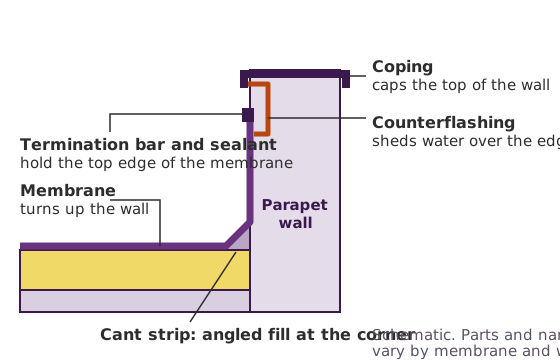
- Coping caps the wall
- Counterflashing sheds water over the edge
- Termination bar holds the sheet's top edge
- Membrane turns up the wall over a cant strip
The model building code says metal edge systems on low-slope single-ply roofs, other than gutters and counterflashing, are designed for wind loads and tested to ANSI/SPRI ES-1. When a parapet is the screen, ask which edge system caps it and whether the quote covers it.
The asphalt roofing manufacturers' ponding bulletin lists runoff from rooftop equipment among the causes of standing water. The units a parapet hides are therefore part of the drainage conversation. The flat-roof guide covers drains and the sheet itself.
FAQ
Questions Sterling owners ask about rubber flat roofs and Loudoun's zoning text
Does Loudoun say a flat roof must be screened?
Section 7.04.05 requires building-mounted mechanical equipment to be screened from view at ground level from public roads and adjoining parcels. It does not name the roof surface.
Does the screening clause apply to a Sterling house or townhouse?
Clause A.4 says it does not apply to residential uses except multifamily attached structures, or to agricultural uses.
Can a parapet count as the screen?
Yes. The ordinance allows an architectural element, and where a parapet is used its height is set by the tallest mechanical unit, capped at 3 feet above the district's maximum height.
Does the county's commercial permit page mention re-roofing?
No. It lists alterations among typical commercial projects without naming roof coverings, so call 703-777-0220.
Which office answers zoning questions about rooftop equipment?
The ordinance site gives Planning and Zoning at 703-777-0246 and dpz@loudoun.gov.
Can Census numbers show how many buildings here have flat tops?
No. It counts homes by building size: 1,450 of 10,102 housing units are in buildings of five or more. Roof shape is not recorded.
Why does rooftop equipment come up in a membrane conversation?
A trade bulletin on ponding lists runoff from rooftop equipment as a cause of standing water, so drainage near the units is worth walking.
Nearby
Where else do we write about rubber flat roofs near Sterling?
Read the Sterling hub, the Reston EPDM page, the Leesburg TPO page, or our flat-roof guide and materials overview.
Talk through the next step
Bring the roof edge and the equipment layout to the call
A short phone call about the parapet, the units sitting on the roof and who owns the building is enough to sort out which Loudoun question comes first.
9220 Topaz St, Fairfax, VA 22031
Mon to Fri 7 AM to 8:30 PM, Sat 7 AM to 8 PM, closed Sunday