TPO roofing in Leesburg, VA: what the Town's design guidelines say about flat roofs and rubber membrane

None of the Town's design guidelines uses the word TPO. They do describe flat roofs behind parapets, and one line sorts "rubber membrane" by whether the street can see the roof.

Which Town document is open on your desk, and can the street see the roof?

Is the building in the Old and Historic District or in the Gateway District?
Old and Historic DistrictThe 2009 Design Guidelines apply. Their roof list names no membrane, and they describe commercial shed roofs "hidden behind parapet walls".
Gateway DistrictThe 2020 Gateway guidelines apply, and they do name rubber membrane. Answer the second question.
Gateway: can anyone on the public right-of-way see the flat roof surface?
NoLine 12 reads as leaving room for rubber membrane on a flat roof that is not visible from the public right-of-way. Confirm with staff that your roof counts as not visible.
Yes, or unsureThe same line points toward "not appropriate".

A building in neither district is outside these two documents, and the Leesburg roofing page shows how to check an address and which counter issues the permit.

Two documents, two ways of treating the same flat roof

Old and Historic District Design Guidelines, 2009

Chapter 5 lists the traditional roof materials as standing-seam metal, slate, wood, asphalt shingles, clay and concrete tiles. It asks owners to replace with a material that matches the original, or "another traditional material" where that suits the building. Chapter 7 says commercial roofs are generally shed or gable, and warns against flat or low-pitched primary roofs without a parapet wall.
Gateway District Design Guidelines, adopted December 8, 2020

The materials list says roofs should use quality materials such as metal or textured asphalt shingles, then adds that "Flat roofs may employ other materials such as a rubber membrane." Two items later, the list gives the condition quoted in the table below.

The parapet is the part both documents keep coming back to

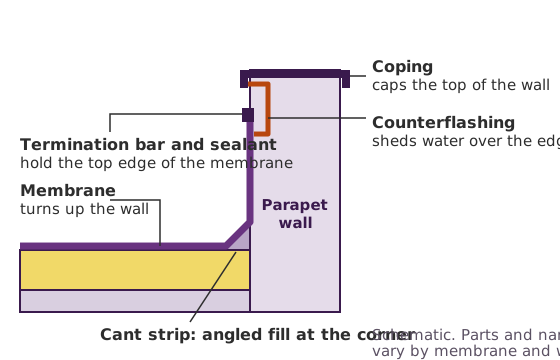
Cross-section where a flat roof meets a parapet wall: the membrane turns up the wall over a cant strip, ends under a termination bar and counterflashing, and the wall is capped by a coping.
Generic schematic. Parts and names vary by building.
  1. The wall that rises above the roof: the Old and Historic District glossary calls a parapet "a low wall that rises above a roof line"
  2. The roof behind it: shed roofs, in the Guidelines' words, "typically hidden behind parapet walls"
  3. Rooftop equipment: the Gateway guidelines picture "Integral parapet and roof elements" screening it, and ask that equipment be screened on all sides
  4. Coping and counterflashing: exterior parts of the wall

Five lines, what each says, and what each leaves open

Line, and where it sitsWhat it saysWhat it leaves open
Gateway, materials, item 12 (page 3.29)"Roll roofing, built-up tar and gravel, rubber membrane, plastic or fiberglass roofing materials are not appropriate unless they are used on flat roofs not visible from the public right-of-way."It does not define "rubber membrane", name TPO, EPDM or PVC, or say how "not visible" is measured.
Gateway, existing structures, item 1c"Traditional roof forms and materials should be used," and flat roofs with parapet walls are named among the most common forms in Leesburg.It does not say whether item 12 reaches a re-roof of an existing flat roof, since item 12 sits in the new-construction materials list.
Old and Historic District, chapter 5, roofs (pages 50 and 51)Replace with a matching material or "another traditional material"; no membrane is named among the traditional ones.It does not say how a hidden shed roof behind a parapet is treated when only its covering changes.
Old and Historic District, chapter 5, inappropriate treatmentsNo vents, skylights or solar panels "unless placed inconspicuously on secondary elevations".It says nothing about rooftop mechanical units on an existing building.
Both, rooftop equipmentNew buildings: integrate it and screen it on all sides. Gateway: screen equipment visible from the district.No height, setback or screen material is given for a unit already on a roof.
Check first

A hidden roof is still an exterior change in the Old and Historic District

The Town's Old and Historic District page says a Certificate of Appropriateness is needed for all exterior changes before work begins, and its Certificates page lists in-kind roof replacement as a staff-level approval. Whether a new membrane on a roof the street cannot see counts as in-kind is for the staff to say.

What to put in front of Preservation staff

The Town's Preservation Manager is listed at (703) 771-2773. Two questions came up while reading; ask them before a membrane is chosen.

  • Does Gateway item 12 reach a re-roof?Ask whether the line applies when an existing flat roof is re-covered, or only to new construction.
  • What does "not visible" mean?Ask whether staff judge it from the street in front, from every public vantage, or from a stated distance.
  • Photographs from the public sideTake views of the parapet from the sidewalk and across the street.
  • The equipment on the roofList each unit and vent, and where it sits relative to the parapet.

Questions about flat roofs under Leesburg's guidelines

Does any Leesburg design guideline name TPO?

No. The Gateway guidelines say "rubber membrane" and the Old and Historic District Guidelines name no membrane at all. Whether a given single-ply sheet falls under the Gateway phrase is a question for staff; our flat roof page explains how single-ply roofs are built.

If my flat roof sits behind a parapet, does the street not see it?

The guidelines do not give a test. A parapet hides a roof from some places and not from others, and the text sets no height or sightline.

Does the Gateway rubber membrane line apply to an old building, or only to new ones?

The line is in the materials list for new construction, while the existing-building item asks for "traditional roof forms and materials".

Is the Gateway District the same area as the Old and Historic District?

No. They are separate districts with separate guidelines, from 2020 and 2009, and the Town's Certificates page treats them as different review areas.

What do the guidelines say about air-conditioning units on a Leesburg flat roof?

For new buildings, equipment is to be integrated and screened on all sides. The Gateway site-design list asks owners to screen rooftop equipment that is visible from the district.

Do the guidelines say anything about the color of a flat roof?

The roof lines quoted here name materials and forms, not membrane color. For an existing roof, the Old and Historic District asks that a replacement match the original in color.

Keep reading

The Leesburg roofing page covers permits and the county and Town split. The Leesburg metal roof page reads the same 2009 guidelines for metal, and the Falls Church TPO page covers another office. For how membrane roofs are built and repaired, see the flat roof guide.

Sources, checked October 12, 2026. The Town's server refuses automated downloads of its PDFs, so the guideline quotations come from archived copies of the Town's PDFs held by the Internet Archive; the page numbers are those printed in the documents. The Town's own Old and Historic District page, opened live, lists the 2009 edition as current. Old and Historic District page, Certificates of Appropriateness page (opened October 11, 2026), Design Guidelines chapter 5 (archived copy), chapter 7 (archived copy), Appendix D glossary (archived copy), Gateway District Design Guidelines (archived copy).

Talk through the next step

Talk through your roof with King's Roofing

Share the address, what you are seeing on the roof and the decision you need to make. We will tell you what to expect before anything is scheduled.

Book a free 15-minute phone consultation (703) 712-1506

9220 Topaz St, Fairfax, VA 22031
Mon to Fri 7 AM to 8:30 PM, Sat 7 AM to 8 PM, closed Sunday

Call (703) 712-1506Book a Call