The marking
In the guidelines' list of districts, Kensington carries an asterisk, which the note defines as having district-specific guidelines of its own.
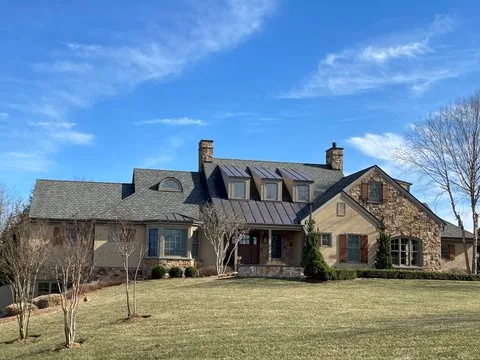
When Montgomery County adopted the Vision of Kensington, its roof survey noted that a surprising number of houses in the district still had their original standing seam metal. Metal here is often an old roof to keep before it is a new roof to buy.
Roof by roof
Shares come from the district plan's own survey of the historic district, plus one Census figure for the apartment side.
The plan calls the gable the dominant roof form here, with end gables, cross gables and elongated gables on the Queen Anne and Shingle houses. Those roofs meet at valleys, dormers and bays, so a metal question on one of them is really a question about many joints.
The plan adds that most buildings have received replacement roof cladding, so the covering you see may not be the first one.
These are the Bungalow and American Foursquare houses of the district. A hip has no gable ends, which makes the roof a plainer shape, and the same preserve-first reading applies to whatever covers it.
The survey puts 33 percent of dwellings at a partial or full front porch with fan brackets and turned spindles, 26 percent at a wrap-around porch and 22 percent at a one-story entry porch. A porch roof is small, sits low and is seen from the sidewalk, which is why a metal porch roof draws more attention than its size suggests.
It is also the roof most likely to be a separate question from the main roof, so the two can need different answers.
These roofs are mostly low-slope, so the metal conversation barely starts; see the flat roof guide instead. The Census counts these homes by building size, not by whether they lie inside the district line, so the parcel decides which office is involved.
What the county says
The county's design guidelines for historic sites and districts list standing seam metal among the traditional roof materials, beside slate, wood shingle and tile. One photo caption goes further: a metal seam roof is a traditional material and should be preserved and maintained.
Guideline 5.4 asks owners to preserve original roof material and replace it with similar material only when necessary. Guideline 5.5 encourages replacement in kind and asks that new material match the original in scale, color and texture as closely as possible.
District rules
In the guidelines' list of districts, Kensington carries an asterisk, which the note defines as having district-specific guidelines of its own.
The county text may supplement a district plan, and where the two conflict the district-specific guidelines prevail.
The Vision of Kensington was prepared in August 1992 and adopted by the County Council on November 4, 1997.
Nothing in the plan text read for this page rules metal in or out. It records the roofs that were there, which is the baseline a reviewer would compare a change against.
Who decides
| Your plan | Who decides |
|---|---|
| Repair an old metal roof with the same material and design | Montgomery Planning lists matching roof repairs as work that does not involve the Historic Preservation Commission. Confirm the scope with the Historic Preservation Office, 301-563-3400. |
| Replace worn metal with new metal of the same look | The guidelines encourage replacement in kind. Ask the Historic Preservation Office whether the job counts as a repair or needs a Historic Area Work Permit. |
| Replace shingle or shake with metal | That is a change of exterior material, which the HAWP list names. Call the Historic Preservation Office before any material is ordered. |
| Replace original metal with another covering | The same list applies, and the district plan's note about original seam roofs is the context a reviewer has on file. |
| House outside the historic district | No commission step. The Town and county questions on the Kensington page still come first. |
The permit page also names Kensington among places where the municipality may review changes before the HAWP application, so the Town call comes first. For metal in general, see metal roofing compared; for neighbors, Silver Spring and Rockville.
FAQ
Yes. Its roof survey says most buildings have replacement cladding but a surprising number of houses retain their original standing seam metal.
The county's guideline list still marks Kensington as having district-specific guidelines. Ask the Historic Preservation Office which documents it applies to your house.
No count is printed here. The plan gives a description, not a current number, so a roof's own condition is the better guide.
Montgomery Planning lists roof repairs with matching materials and design as work outside commission review. Whether your patch qualifies is a question for its staff.
The HAWP list includes changes to exterior materials, and a covering swap looks like one. Ask before ordering.
Only 16 percent of surveyed houses lack a porch projection, so porch roofs are part of nearly every street scene the district protects.
It lists standing seam metal as traditional and asks that replacements match the original, so the starting question is what was there before.
Next step
Describe the roof and which street it faces. We will help you sort out which office to ask before a metal panel is ordered. More repair help is on roof repair, and all areas are on service areas.
Checked October 11, 2026: Vision of Kensington, county design guidelines, general rehabilitation, county design guidelines, historic districts, Historic Area Work Permits and Census Reporter, Kensington (checked October 10, 2026).
Talk through the next step
Share the address, what you are seeing on the roof and the decision you need to make. We will tell you what to expect before anything is scheduled.
9220 Topaz St, Fairfax, VA 22031
Mon to Fri 7 AM to 8:30 PM, Sat 7 AM to 8 PM, closed Sunday