PVC Roofs in Oakton, VA
PVC is a plastic sheet whose seams are fused with hot air. Whether it belongs in an Oakton conversation depends on which buildings you own, so this page reads the county's own planning text for Oakton first and the material second.
The plan text
What does Fairfax County's plan say about the buildings of Oakton?
The Piney Branch sector "primarily consists of single-family detached residential units." "Townhouses and garden-style multifamily residential units are present along the southern boundary of the planning sector, with community-serving commercial uses located at the intersection of Chain Bridge Road and Hunter Mill Road."Fairfax County Comprehensive Plan, 2026 Edition, Area Plans, Vienna Planning District, sector V4 Piney Branch. Read October 14, 2026.
The same sector text limits future commercial use to the existing Oakton shopping center site and land already zoned for it, and rules out new strip commercial along Chain Bridge Road. Our reading: the buildings most likely to carry a commercial membrane stay a small set of existing parcels. The plan does not count them or describe their roofs, so neither the plan nor this page can say how many are flat.
What does Fairfax County's plan say about which roofing material to use in Oakton?
Nothing. It decides where commercial and residential uses may go, not how a roof is covered, and the Census cannot tell a flat roof from a pitched one. So a PVC proposal for an Oakton building is not encouraged or excluded by the planning text we read. It stands on the building: its slope, its drains, who owns it and what the data sheet says.
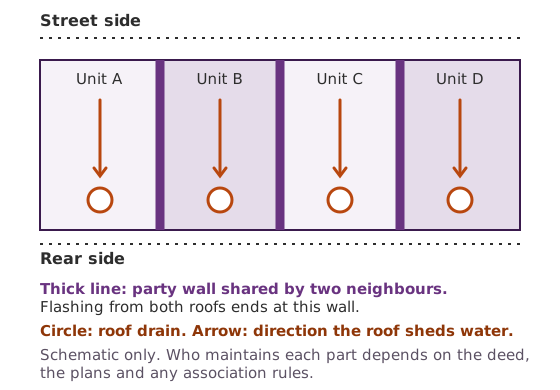
If a townhouse row had a flat section
- Party wall: the roof sheets of both neighbours end here, so a seam at the wall belongs to two owners.
- Drain: one per unit in this sketch. Ask which drain serves which owner.
- Street and rear edges: the sheet is finished with edge metal, a line item to ask about.
Does PVC suit a townhouse row?
The plan names townhouses but is silent on coverings. Pitched sections are shingle questions; PVC is only on the table for a flat piece.
Who maintains the wall seam?
Deeds, plans and association rules decide. Ask for them before comparing materials.
Who owns the big buildings
When were Oakton's larger buildings built, and who lives in them?
Census Bureau table B25127, ACS 2024 5-year, occupied homes in buildings of five or more units, shown as owner-occupied / renter-occupied. Margins of error are wide, so treat each figure as a sketch.
| Building size | Built 1960 to 1979 | Built 1980 to 1999 | Built 2000 or later |
|---|---|---|---|
| 5 to 19 units | 365 / 747 | 196 / 855 | 82 / 188 |
| 20 or more units | 136 / 278 | 298 / 385 | 446 / 784 |
The smaller buildings are mostly the older ones: about 2,160 of the roughly 2,560 occupied homes in 5 to 19 unit buildings were built from 1960 to 1999, and about three in four of those are rented. The 20-plus buildings lean newer, with roughly 1,230 of about 2,370 built from 2000 on. The Census says nothing about roof age or shape, so the roof's own records, not the year on the building, are the thing to ask for.
Both groups are mostly rented, so the person choosing a roof is usually a landlord, a management company or a board. For that reader the first question is not a material but a scope.
If PVC is proposed
What should a PVC quote for an Oakton building put on paper?
The neutral sources we opened support only a few things about PVC, so the list is short and each item can be checked.
- The standard on the data sheetThe building code table lists PVC under ASTM D4434. A named standard is easier to compare than a trade name.
- How the welds are made and checkedNRCA's library describes PVC as a thermoplastic whose sheets fuse under heat, and a correct weld can only be separated by tearing the sheet. Ask who tests the welds, especially at a wall like the one in the plan above.
- What is not claimedNo neutral source we opened gives a PVC-only advantage, so be careful with one made in a sales sheet. Ask for the manufacturer's data sheet and read what it actually states.
- Slope, drains and edgesSingle-ply sheets share one set of drainage and edge-metal questions; our flat roof page walks through them.
FAQ
Questions from Oakton owners and managers about PVC
Is my Oakton commercial building in the plan's shopping center area?
The plan names the existing Oakton shopping center site and land already zoned for commercial use. It does not map your parcel in its text, so check the county's zoning map or ask the county.
Does the county plan favor PVC over other single-ply sheets?
No. The sector text we read never names a roofing material, so it favors none.
Are garden-style buildings in Oakton usually flat roofed?
We cannot say. The plan and the Census describe use and size, not roof shape. Look at the roof or the plans.
Why does the era a building was built matter for this question?
It points to who may have records and whether the roof has been replaced already. It does not tell you the roof's condition. Ask for the roof history.
Is PVC the same as TPO?
They are both thermoplastic sheets with hot-air welded seams, but they are listed as different products under different standards in the building code table. Compare data sheets.
Keep reading
Where can you read more near Oakton?
Back to the Oakton page, the flat roof guide and the materials page. On the building types of the same place, see EPDM roofs in Oakton. Neighbors with their own PVC pages: Fairfax and Reston.
Pages used
Checked October 14, 2026: Fairfax County Comprehensive Plan, Vienna Planning District, Census Reporter, ACS 2024 5-year, table B25127 and the NRCA library entry on single-ply seams.
Talk through the next step
Talk through your roof with King's Roofing
Share the address, what you are seeing on the roof and the decision you need to make. We will tell you what to expect before anything is scheduled.
9220 Topaz St, Fairfax, VA 22031
Mon to Fri 7 AM to 8:30 PM, Sat 7 AM to 8 PM, closed Sunday