A flat roof in Chevy Chase is measured, not matched: what three codes say about its height
No Chevy Chase code we read names TPO, single-ply or membrane roofing. Three of them do define how tall a building is, and the flat roof gets its own wording in each. For a flat-roofed rear addition, garage or shed, those sentences are the closest thing to a local rule.
Section 3
Which point on a flat roof does Section 3 count as the top?
Highlighting is ours.
"Building height" means the vertical distance measured from the average elevation of the grade along the façade of the building facing the front lot line to: (1) the highest point of roof surface regardless of roof type, and (2) the mean height level between the eaves and ridge of a gable, hip, pyramidal, mansard, or gambrel roof.Section 3 Ordinance, Section 6-101(e). Checked 12 October 2026.
Section 6-303 caps a main building at 35 feet to the highest point of roof surface, or 30 feet to the mean level for the pitched forms. The permit list in 6-302 includes work that would "increase the height" of an existing building, while ordinary exterior repair, roofing among the examples, needs no Section 3 permit. Nothing connects the two sentences.
Section 5
Why does a flat garage roof get a 12-foot line in Section 5?
The height of an accessory building shall not exceed the greater of: (1) fifteen (15) feet when measured from the average pre-development grade in front of the structure to the highest point of roof surface regardless of roof type.Section 5 Ordinances, Sec. 9-112(b). Posted copy marked Resolution No. 12-25-1, effective 2/3/2026. Checked 12 October 2026.
The 12-foot line comes from the setback rules in Sec. 9-113(b)(4). An accessory building taller than 12 feet with a flat roof, or 15 feet to the ridge of any other roof, has its side and rear setback increased by two feet for each foot over, and the increase applies to the entire building.
One oddity in the posted PDF: Sec. 9-112(a) reads "thirty-two (33) feet" and "twenty (28) feet," so words and numerals disagree. If a plan sits near the limit, ask the Section which governs.
Chevy Chase View
Does Chevy Chase View measure to the membrane or to the parapet?
"Height" means the vertical distance measured from the average elevation of the ground along the front of the structure to the highest point of the roof surface or parapet wall for a flat or shed roof, or, for a gable, hip, mansard, or gambrel roof, the mean height between the eaves and ridge of the roof.Chevy Chase View Municipal Code, Sec. 13-101(20). Checked 12 October 2026.
Sec. 13-403(b) adds 1.5 feet of side and rear setback for each foot a non-main structure rises above 15 feet, with no separate figure for flat roofs. The repair exemption in Sec. 13-202(c) is conditioned on the "same height," and it leaves the measuring to the definition above.
Where the membrane sits
What is stacked between the deck and the highest point?
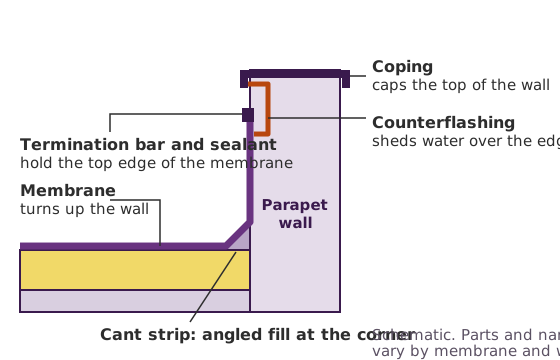
TPO, a single-ply sheet, is the top layer in the generic section drawn for our flat roof guide, over a deck, a vapor retarder or air barrier, insulation boards where the design includes them, and an optional cover board.
On the parapet detail at right, the membrane turns up the wall and stops beneath a termination bar and counterflashing, and the wall wears a coping. Read as a drawing, the wall's highest point is the coping, not the sheet. That reads a schematic, not any Chevy Chase office, so ask how the office measures.
No text read says a membrane re-roof changes measured height
None of the three codes mentions TPO, single-ply or tapered insulation, and none says that a new membrane, a cover board or extra insulation raises the height they measure. Nor does any say it does not. The gap matters only for a roof already near a limit, and then the answer should come from the office in writing.
Before the order
Four questions to settle on a flat-roofed addition before TPO is ordered
1. The office
Match the address to an office on the Chevy Chase page. Each defines height differently.
2. The tallest point
Find it on your roof: the membrane, the edge metal, or the cap of a parapet.
3. The question
Ask the office in writing whether a re-roof that adds layers counts as a change in height.
4. The scope
Have each layer above the deck listed in the written scope, so the answer can be checked against it.
Questions
Short answers on flat-roof height in Chevy Chase
Do Section 3, Section 5 or Chevy Chase View mention TPO?
Not in the sections opened here. Their words are roof surface, roof type and parapet wall, used for height, not material.
How much extra setback does a flat-roofed shed trigger in Section 5?
Two feet per foot over 12, on the entire building.
Why does the Section 5 height line print two different numbers?
The posted copy spells out one figure and writes another in numerals. Only the Section can say which governs.
Is the 30-foot test in Section 3 available to a flat roof?
That test lists gable, hip, mansard and gambrel forms, so a flat roof is measured by the 35-foot test.
Is the parapet counted in Chevy Chase View only on a flat roof?
The definition names it for a flat or shed roof. Pitched forms use the mean height between eaves and ridge.
Are the Town of Chevy Chase and the Village covered here?
No. Their height texts were not read here, so call those offices.
Other Chevy Chase roofing on this site: metal roofs in Chevy Chase, which reads the historic texts. For the countywide roof-reflectance amendment, see EPDM roofs in Bethesda, and for a city that wrote its own low-slope roof rule, TPO roofing in Rockville. The wider view is in the flat roof guide.
Official pages used, checked 12 October 2026: Section 3 ordinance; Section 5 ordinances; Chevy Chase View code.
Talk through the next step
Bring the street and the roof's current layers
Tell us whether the flat roof sits on an addition, a garage or a shed, and what is under the membrane now. We will help you work out which office to ask about height before anything is ordered.
9220 Topaz St, Fairfax, VA 22031
Mon to Fri 7 AM to 8:30 PM, Sat 7 AM to 8 PM, closed Sunday