TPO roofing in Manassas, VA: what the City's historic guidelines say about membrane roofs
Downtown Manassas is a street of flat-roofed brick buildings, and the City wrote a rule for their roofs into its Historic District Design Guidelines. TPO is one kind of membrane, so that rule is the first thing to read before a downtown roof is priced. The short version: membrane is acceptable on a flat or shed roof that is not highly visible, and the guidelines name no product.
Does it reach your building
Start with the City's list: who decides, and in what order?
First: the City's list of structures
Every building in the local district is designated Landmark, Contributing or Non-contributing, and the guidelines say most of their rules apply only to the first two. Non-contributing buildings are typically ones built after the district's period of significance, 1850 to 1936. The City keeps the list; Planning and Development answers at 703-257-8278.
Stop here if the building is outside the district: the Manassas page covers the permit sideSecond: staff, then possibly the Board
The guidelines say staff decide whether a project can be approved administratively or needs a Certificate of Appropriateness from the Architectural Review Board. Minor work not needing one is delegated to staff under the zoning ordinance.
Third: the building permit
The guidelines add that most work needing a Certificate also needs a building permit, and that the district rules sit on top of the usual codes, not in place of them.
The guidelines add that unapproved exterior work can bring a stop-work notice and may have to be altered to match. Call before a membrane is ordered.
The line that matters
The Design Review Guide line on membrane roofs
Membrane and built-up roofs are appropriate on flat or shed roofs (typically present on commercial structures) when they are not highly visible from any façade of the building.
City of Manassas, Historic District Design Guidelines (adopted April 19, 2022), Design Review Guide for commercial and institutional roofs, printed page 135. Read October 14, 2026, from an Internet Archive copy of the City's PDF, because the City's site blocks automated readers.
Why "visible" is the word
Which downtown roofs can a passer-by actually see?
Shed roofs are found on half of the commercial buildings in Manassas, creating an appearance of a flat roof from the street. These roofs may be metal, membrane, or built up.
Same guidelines, section on roof shapes, printed page 50. Read October 14, 2026.
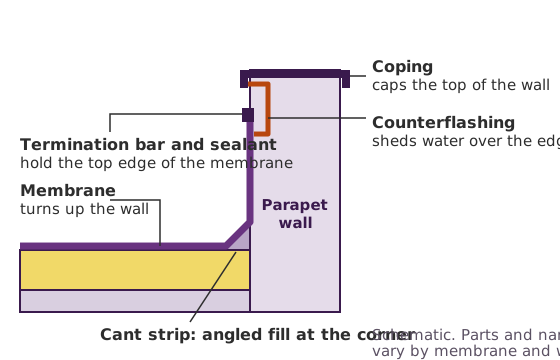
For commercial roofs the City lists "failure of flashing around parapets" among its typical problems and says parapet walls may deteriorate faster from exposure. Its maintenance list opens with one instruction: ensure that coping is watertight. The head of this page shows those parts, with the membrane turned up the wall and capped.
Replacing a roof here means replacing like with like
The general roof guidelines ask owners to repair rather than replace, and at the end of a roof's functional life to use an in-kind material and design. A substitute is allowed where in-kind is not technically feasible, with priority on the roofing seen from the primary facade. Mechanical equipment and antennas go on less visible parts of the roof. A membrane that suits the building is not automatically a substitute for what was there.
Before the phone call
What should a downtown owner have in hand?
- The street address and the building's designationFrom the City's list, or from staff on the phone.
- Photos of the roof edge from the sidewalk and the alleyThey show whether a parapet hides the roof, which is the sentence about visibility.
- A note of every unit on the roofVents, skylights and mechanical equipment are named in the guidelines.
- What covers the roof nowThe guidelines compare against the existing roof, so say whether it is membrane, built-up or metal.
Questions
Questions about membrane roofs under the Manassas historic guidelines
Do the Manassas guidelines mention TPO by name?
No. They say "membrane" and "built-up". TPO is one of the single-ply membranes, and our flat roof page explains how those are laid and welded.
Is a white membrane required downtown?
The guidelines do not mention membrane color in the passages read for this page. Ask staff, and ask your building owner or association whether it has its own rule.
What if my building was built after 1936?
The district's period of significance runs 1850 to 1936, and the guidelines say Non-contributing buildings typically date after it. The City's list decides your status, not the date.
Can solar panels go on a historic flat roof?
The guidelines name a flat roof, or a spot behind a parapet wall, as the kind of low-visibility location to use. The panels should also come off again without harming the original building.
Where does a rooftop unit go on a historic building?
On a less visible part of the roof, on a roof that does not define the building's character, or on a non-historic neighbor, according to the commercial roof guidelines.
Does this apply to a house or townhouse outside the district?
No. The guidelines cover the local historic districts. Other Manassas roofs follow the permit rules on the city page.
Does a metal roof get the same treatment as a membrane?
The same chart lists metal seam, stamped tin and snap-lock rows with their own marks, and says corrugated panels are not appropriate on contributing structures. Membrane has its own row.
More on membrane roofs: TPO roofing across Northern Virginia, the materials overview, and neighboring pages for Fairfax and Reston.
Official pages used
Checked October 14, 2026: the City's Historic Overlay District page (archived copy read) and the Historic District Design Guidelines PDF it links (archived copy read; page numbers are the printed ones).
Talk through the next step
Talk through your roof with King's Roofing
Share the address, what you are seeing on the roof and the decision you need to make. We will tell you what to expect before anything is scheduled.
9220 Topaz St, Fairfax, VA 22031
Mon to Fri 7 AM to 8:30 PM, Sat 7 AM to 8 PM, closed Sunday