91 in North Fairlington
Flat roofs with parapets, out of 433. They sit in three building types of 52, 23 and 16 buildings, each a two-story brick townhouse pair.
Most Arlington roofs are not flat. In Fairlington, the garden-apartment community along Interstate 395, the 1999 National Register nomination counts 107 flat-roofed buildings by hand, and for 91 of them it names a brick parapet. EPDM is a rubber sheet for exactly that kind of roof, so this page reads the nomination and the owners' association form together.
The count
The nomination lists 1,020 contributing residential buildings, 587 in South Fairlington and 433 in North. It says gable and hipped roofs predominate and most roofs are slate. It also sorts every building by roof shape.
Flat roofs with parapets, out of 433. They sit in three building types of 52, 23 and 16 buildings, each a two-story brick townhouse pair.
One building type, out of 587. The inventory describes it as a flat-roofed two-unit townhouse and names no parapet for it.
Our arithmetic from the two counts: about one residential building in ten. The nomination does not give that percentage, and it describes roofs as of 1999.
Why the edge matters
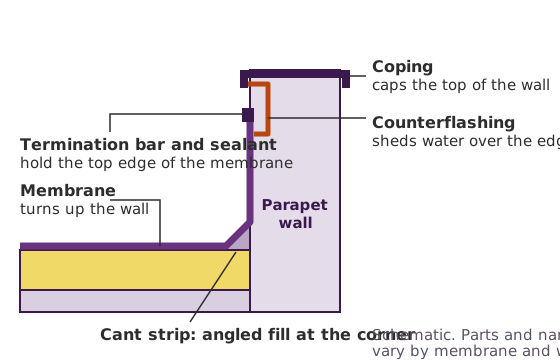
For the three North Fairlington types the nomination describes a brick parapet above a limestone or raised brick band, with wooden vents and glazed coping tiles in the parapet. A rubber sheet that stops at the roof edge is only half of such a roof; the sheet also has to climb the brick and finish under something.
The model building code's reroofing section says existing vent flashing, metal edgings, drain outlets, collars and metal counterflashings shall not be reinstalled where rusted, damaged or deteriorated. On a parapeted roof, that sentence covers most of the perimeter. Whether a given building's wooden vents and coping can stay as they are is a question for whoever inspects it, not something the nomination can answer.
Where EPDM comes in
Our flat roof page sets EPDM beside TPO, PVC and modified bitumen, and EPDM roofing in Falls Church works through another city's printed design loads.
Who decides
First: the condominium association
Fairlington Villages' variance form requires written approval before work that alters the exterior appearance of a building, and says all work must follow the building permit. The form never uses the word roof, and none of the thirteen standard policies on the Architectural Control page is about roofs. Ask the Management Office who handles a flat roof's covering and edge.
Second: the county's historic-preservation page
The county calls the National Register an honorific list and shows Fairlington on it. No county page tying a roof rule to that listing turned up in our reading. The local districts are covered on our Arlington metal page. Historic Preservation can confirm.
Third: the building official
Permit questions, including how larger residential buildings are treated, are set out on the Arlington page and the Arlington TPO page. Call Permit Arlington Center at 703-228-3800 with the unit count.
The association's by-laws and policies page stayed unread, so who owns a roof covering under the declaration is open. Nothing we opened describes the roofs of any Fairlington building today, or says whether EPDM is on any of them.
FAQ
The county's page lists it among National Register districts, which it calls an honorific list. We read no county page that adds a local review to it.
No. It counts flat roofs and describes parapets, vents and coping tiles, and says most roofs are slate. It names no membrane.
It notes a small number of buildings are in the city of Alexandria, so the address decides which jurisdiction answers permit questions. See Alexandria.
The nomination says units were renovated and sold as condominiums between 1972 and 1977, after being a rental community.
Walls on the roof perimeter can trap water. The model code's new-design rule asks for overflow drains or scuppers in that case, with an exception when an existing roof is replaced. Ask what the building has now.
The single-ply trade association advises at least twice a year and after any major storm, checking perimeters, flashings around penetrations and open drains.
More low-slope reading: the materials guide and our service areas.
Sources read (association pages and the nomination checked October 16, 2026; county page as an archived copy):Talk through the next step
Give us the street address, the building type, whether a brick parapet rings the roof and where water shows inside. We will say whose approval to ask for before anyone is scheduled.
9220 Topaz St, Fairfax, VA 22031
Mon to Fri 7 AM to 8:30 PM, Sat 7 AM to 8 PM, closed Sunday