PVC roofs in Chantilly, VA and what the federal storm record says about roofs here
If a building on Route 28 or Willard Road has a white membrane and someone tells you wind will find it, check the record first. The National Weather Service logs storm reports by community, and Chantilly has a short list worth reading before you decide anything.
NOAA's Storm Events Database holds 24 entries placed at Chantilly from 2012 through September 2026. Two describe a roof, and both describe metal. None names PVC or any membrane.
- Most wind entries name trees and wires
- The hail entries state no roof damage
The record
Which Chantilly storm entries mention a roof or hail, and in what words?
We read the database's bulk files for 2012 to 2026 and kept entries whose location label is Chantilly in the Fairfax or Loudoun forecast zones.
- 6 May 2015, hail
Half-dollar-sized hail, recorded as 1.25 inches. The entry says nothing about roofs.
- 18 June 2015, hail
Hail recorded at 2.00 inches by a trained spotter. The narrative field holds only a spotter code, so it tells us nothing else.
- 23 May 2019, thunderstorm wind
A public report: metal panels blown off the roof of the Udvar-Hazy Center. The gust is listed as an estimated 70 knots, about 81 mph by our conversion.
- 26 May 2021, thunderstorm wind
A 911 call-center report: part of a tin roof removed from an office building in the 14300 block of Willard Road, with many trees down nearby. Estimated gust 65 knots, about 75 mph. The entry's damage field lists 200 thousand dollars for the whole event, not the roof alone.
- 8 September 2023, hail
Spotters reported quarter-sized hail in the Chantilly and South Riding areas. This one is filed under Loudoun County, labelled Pleasant Valley, and states no roof damage.
Reading it carefully
What can a building owner reasonably take from those entries?
What the database does not say about a PVC roof
It names no roof membrane at all. Of the 24 Chantilly entries, 15 are thunderstorm wind, 6 flash flood, 2 hail and 1 flood. The two that mention a roof both describe metal coverings. Our reading: an empty field is not evidence that membranes survived, because nobody was asked to record roof type.
What "tin roof" most likely means in the 2021 entry
The words come from the report, not from a material test. We read them as a metal roof covering on an office building. It is a report from a call center, so treat it as a pointer, not a finding.
Why hail entries are not roof damage entries
The model building code asks low-slope roof coverings to resist impact damage under named test methods, and it does not say "hail" in that clause. Nothing we read links these Chantilly hail sizes to a membrane failing, so we draw no conclusion about PVC.
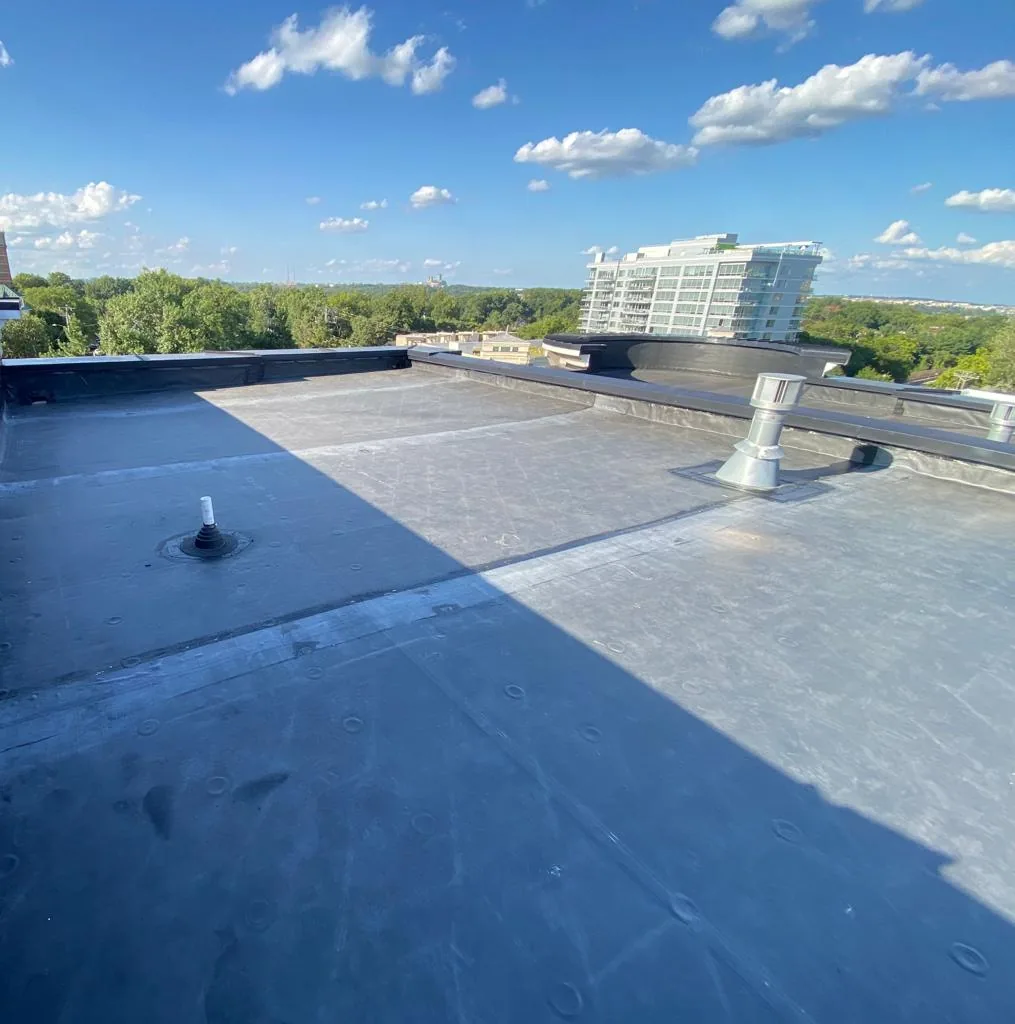
Who owns the larger roofs
How old are the apartment buildings whose roofs a membrane might cover?
Census 2024 five-year estimates for the Chantilly place count 661 occupied homes in buildings of five or more units. Of those, 136 are in buildings from 2020 or later, 292 from 2000 to 2019, 228 from 1980 to 1999, and just 5 from before 1980.
That is 656 of 661, or 99.2 percent, from 1980 onward, by our arithmetic. Census counts homes, not roofs, and these are sample estimates with margins of error. It does not say what any roof is made of. The practical use: for a newer building, the roof's original documents are likelier to exist, so ask the manager for them.
After a wind event
What should you ask about after a wind storm hits a low-slope roof?
- Walk the perimeterThe single-ply trade association tells owners to look at roof edges for loose metal or fasteners after a major storm. The flat-roof guide covers the rest.
- Ask about old edge metalThe model code bars reusing existing edge metal and flashings that are rusted, damaged or deteriorated. Ask what the scope does with them.
- Name the sheetThe model code lists PVC under ASTM D4434. Ask for that standard on the data sheet, since color alone does not identify the material.
- Date your photosPictures of the edge before and after a storm help any later conversation. This one is our own suggestion, not a code item.
Official pages
Where can you check these entries and the county's permit lists yourself?
Checked October 15, 2026: the National Centers for Environmental Information Storm Events Database (events 825980 and 951269 are the two roof entries), the Census Bureau's American Community Survey table B25127, and Fairfax County's list of work that needs a permit. The county list has a commercial section that names re-roofing and roof repair and is silent on membrane type. For the county test and the Loudoun side of ZIP 20152, see our Chantilly page. Nearby, the EPDM and TPO pages read the county plan, and the Ashburn PVC page covers Loudoun. The roofing materials comparison has the rest.
FAQ
Questions Chantilly owners ask about PVC and the local storm record
Does any Chantilly storm entry say a roof was PVC?
No. The two roof entries describe metal panels and a tin roof, and no entry names a membrane.
Does the 24-entry count show how many roofs were damaged?
No. It counts reports filed under the Chantilly label, mostly trees, wires and flooded roads. Many damaged roofs may never have been reported.
Can you tell from the ground that a white roof is PVC?
Neutral trade sources we read give no reliable ground-level test. White membranes can be PVC, TPO or EPDM, so check the data sheet.
Was the 2019 gust at the Udvar-Hazy Center measured?
No, it is marked as an estimated gust of 70 knots, from a public report.
Does a Loudoun-zone entry change which office I call?
The 2023 hail entry is filed under Loudoun, while ZIP 20151 is Fairfax. Your parcel decides, so use the county test on our Chantilly page.
Talk through the next step
Bring the storm date and the roof edge to the call
Tell us the street, what the building is, and what the roof did or did not do in the last big wind. A short phone call comes first.
9220 Topaz St, Fairfax, VA 22031
Mon to Fri 7 AM to 8:30 PM, Sat 7 AM to 8 PM, closed Sunday