TPO Roofs in Kensington, MD
A white membrane is an answer for flat roofs, and Kensington's own district plan counted them: 22 of 181 buildings. The plan never says what should cover them.
TPO belongs on the flat or nearly flat roofs, not on the gabled roofs that fill most of the district. For a Howard Avenue building the open question is review, not the membrane.
- 22 flat roofs counted among 181 buildings
- No membrane named in the plan or the county roof guidelines
The count
How many flat roofs did the Kensington district plan record?
The Vision of Kensington includes a frequency report of roof shapes. It lists 181 coded buildings: 96 gabled, 30 hipped, 22 flat, 14 cross gabled and 6 gambrel, with the rest in small mixed codes, two of which include a flat section. Flat is the third most common shape, about one building in eight. The same plan counts 20 commercial and five apartment buildings among the 181.
Our reading, not the plan's: 22 flat roofs and 25 commercial or apartment buildings are close numbers, but the plan does not tie one to the other. The counts come from scanned pages, so read them as the plan's picture of the district.
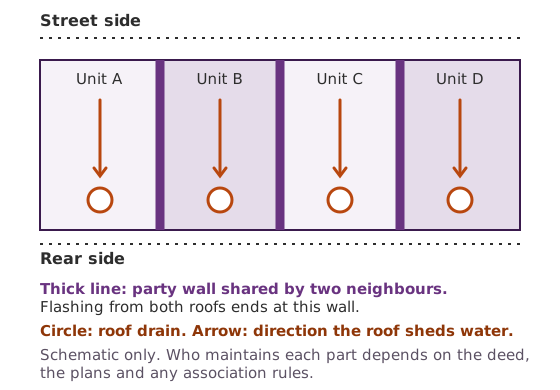
Why the strip matters
The plan describes the commercial strip along Howard Avenue and the tracks as one- and two-story buildings, uniform in height, that share party walls or stand very close together.
- A shared wall is a roof edge two owners may care about
- The plan calls the facades flat and says nothing of the roofs behind
Is TPO even a candidate?
Which Kensington roofs could take a single-ply membrane?
| Roof type | TPO a candidate? | Who decides first |
|---|---|---|
| Gabled, hipped or cross-gabled house roof | Not the usual fit. The model building code gives single-ply a minimum design slope for drainage, and these roofs are steep. See materials instead. | The county commission, if the house is in the district and the covering changes. |
| Small flat section on an older house | Ask. It may suit, but the district's own roof text is written for pitched houses. | Montgomery Planning counts matching roof repair as outside the commission. A new covering of another kind reads as a material change. |
| Howard Avenue commercial building | Candidate if the roof behind the facade is flat or low-slope. Confirm from the roof, not the street. | The Town first, then the county commission if the parcel is in the district. |
| Apartment building | Candidate where the roof is flat. The Census counts 315 homes in buildings of 50 or more units and only 77 in buildings of 5 to 49. | The owner or board; the parcel decides whether the district applies. |
The Census counts homes by building size, not by district line, and its margins are wide at this scale (plus or minus 132 on the 50-or-more figure). For how a TPO roof is built, see the flat roof guide.
What the county's roof guidance leaves out
The county's design guidelines for historic districts say flat roofs appear on some building types, list slate, wood shingle, standing seam metal and tile as traditional roof materials, and recommend traditional materials. A text search of the guidelines chapter, the Vision of Kensington and the Kensington Sector Plan design guidelines turns up no roofing membrane, TPO or single-ply wording. A membrane here is neither named as welcome nor ruled out, so it is a question for the Historic Preservation Office, 301-563-3400, case by case.
Loads belong to the structure
County Executive Regulation 13-24 sets a design ground snow load of at least 30 pounds per square foot and the same figure, non-reducible, for ordinary flat roofs not used as a deck. It also asks for the lower roof beside a new higher one to be checked for drifting snow.
Beside a party wall
Does a flat Howard Avenue roof carry rules of its own?
Those county numbers describe the structure under the covering, and they do not pick a membrane. They matter when a job adds weight or a taller neighbor, so a roof between higher walls is a reason to ask the permit office whether a plain re-cover changes anything.
Before a bid
Four answers to have in hand before anyone prices a membrane
- Is the parcel in the district?The Vision proposed widening the boundary to adjacent commercial areas, and the Sector Plan guidelines split Antique Row (east of Connecticut Avenue) from the warehouses (west). Ask the county office about your parcel.
- What covers the roof now?Matching repair and a different covering are treated differently, so name the present material and the one you want.
- Who looks after the shared wall?Where buildings touch, the deed and the plans say who maintains the edge.
- Has the Town been asked?The county list puts Kensington's Town step first; see the Kensington page.
FAQ
Flat roofs, Antique Row and the district plan
How many flat roofs does the Kensington plan count?
Its roof shape report codes 22 buildings as flat out of 181, and two more mix flat with another shape.
Does the plan say Howard Avenue buildings have flat roofs?
It calls their facades flat and describes one- and two-story buildings of uniform height. It does not describe their roofs.
Does any Kensington historic guideline name TPO?
No roofing membrane wording appears in the plan, the county roof chapter or the Sector Plan design guidelines read for this page.
Is patching a flat roof on Antique Row a commission matter?
Montgomery Planning lists roof repairs with matching materials and design as work outside the commission. Ask its staff whether your patch qualifies.
Would a membrane over an old covering count as a material change?
The permit list names changes to exterior materials. A different covering looks like one, so ask before ordering.
Is all of Antique Row inside the historic district?
The Sector Plan guidelines place it east of Connecticut Avenue. The parcel decides, so confirm with the county Historic Preservation Office.
Why is a steep house roof a poor match for TPO?
Single-ply membranes are low-slope coverings, and the building code gives them a minimum design slope. Steep roofs take other materials.
Do apartment roofs in Kensington need the commission?
Only if the building sits in the district. The Census counts homes by building size, not by boundary.
Keep reading
Where to go next from a Kensington flat roof
Start with the Kensington permit page and the metal roofs page for the pitched houses. For the wider picture see Montgomery County material decisions and flat roofs. Neighbors with membrane pages of their own: Rockville and Chevy Chase.
Official pages used
Checked October 12, 2026: Vision of Kensington, county design guidelines, general rehabilitation, Kensington Sector Plan design guidelines, Historic Area Work Permits, Executive Regulation 13-24 and Census Reporter, Kensington.
Talk through the next step
Tell us what is on the flat roof today
Give us the street, the number of stories and what covers the roof now. We will help you sort out which office to ask before any membrane is ordered.
9220 Topaz St, Fairfax, VA 22031
Mon to Fri 7 AM to 8:30 PM, Sat 7 AM to 8 PM, closed Sunday