Which roofing material fits a Northern Virginia house? Five questions that decide it
Looks and brand names come last. The slope, the approval path, the roof you have now, the test labels and the weight of the covering narrow the choice first.
shingle, metal, slate, shake
membrane
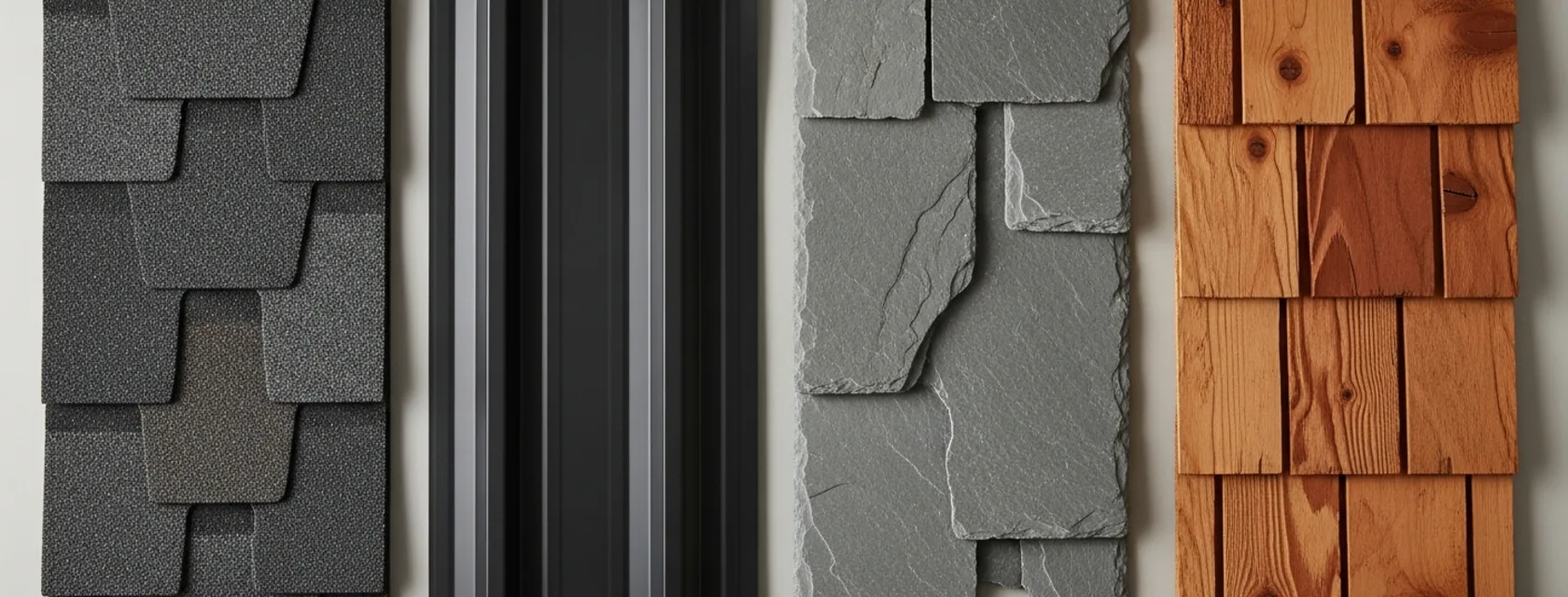
The order that works
Which five questions narrow the material, and in what order?
Each step can remove options before you compare colors. Our roofing materials overview describes what each covering is; this page sorts them by what has to be true first.
- SlopeFirst: what is the slope of each roof section?
Coverings have a minimum slope. The 2021 International Building Code text sets lapped metal panels without sealant at 3 in 12 and lets a maker publish its own minimum. A porch, addition or flat rear section belongs to a membrane, so read our flat roof guide for that part.
Stop here for a near-flat section: choose among membranes
- ApprovalSecond: who has to say yes to a change of material?
An association, a town board, a historic district or a county permit counter may each answer for your parcel. Virginia's building code lets a building official require a permit for replacement roofing in a locally designated historic district. The National Park Service's 1978 roofing brief says a substitute on a visible historic roof should match the scale, texture and coloration of the original. The place-by-place table for metal is in our metal roofing guide, and roof replacement covers permits.
- Old roofThird: what is on the roof today?
The old covering can bar a recover, which changes the work. Virginia's text on that is quoted just below.
- WeatherFourth: what does the local record ask of a label?
NOAA's 1991-2020 normals for the Washington Dulles station show 43.24 inches of precipitation, 21.0 inches of snowfall, 32.7 days a year at 90 F or higher and 101.7 days at 32 F or lower. Those figures do not pick a material. They tell you which claims to test: hail and wind labels, covered in the table.
- WeightFifth: can the roof frame carry the covering?
The Insurance Institute for Business and Home Safety (IBHS) counts slate as a flat tile and says the sheathing must support the load of the tile before it goes on. Virginia's existing-building text requires structural roof components to support the roof covering system and the loads of installation.
The roof you have
What does Virginia's text say about covering the roof you already have?
A roof recover shall not be permitted where any of the following conditions occur:
Where the existing roof covering is slate, clay, cement, or asbestos-cement tile.
Where the existing roof has two or more applications of any type of roof covering.
13VAC5-63-433.3, section 602.3.2.1.2 (Virginia Administrative Code), opened October 16, 2026. A third condition covers a roof that is water soaked or too deteriorated to serve as a base.
Labels to ask for
Which test label or document goes with each roofing material?
The labels come from IBHS Roof 101, opened October 16, 2026. Ask for the label name and class in your written scope, not a brand's description of it.
| Covering | Hail label | Wind label | What else a source says |
|---|---|---|---|
| Asphalt shingles | UL 2218 or FM 4473, Class 1 to 4, on products sold as impact resistant | ASTM D3161 (Classes A, D and F) or ASTM D7158 (Classes D, G and H) | Impact resistance comes from a scrim back or a polymer-modified asphalt. Manufacturers warn that shingles may not seal below 40 F. Designer shingles are styled to look like slate or shake. |
| Metal panels | UL 2218, same classes | Set by panel type; the details are in our metal guide | Each panel type has its own minimum slope. A complete, separate system can go over the old roof under the Virginia text above. See the metal roofing guide. |
| Slate and tile | FM 4473, Class 1 to 4 | ASTM C1568, with C1569 or C1570 for the load on the tile | Sheathing must carry the load. Virginia bars a recover over slate and bars reinstalling broken slate. |
| Wood shake | Ask the maker for the data sheet | Ask the maker for the data sheet | Virginia asks for a gypsum or similar cover before a recover over existing wood shingle or shake. Check association and town rules first. |
| Slate and shake look-alikes | Ask for the same labels, in writing | Ask for the same labels, in writing | Compare data sheets across makers and get association approval before ordering. |
| Flat-roof membranes | Different tests apply; see flat roofs and TPO by place | Seams, drainage and edges decide more than the sheet's name. | |
What do shoppers assume about these labels, and what does the source say?
A Class 4 shingle cannot be damaged by hail.
Under UL 2218, Class 4 means a 2.00 inch steel ball, and a product passes when two impacts in one spot leave no crack visible on the back. IBHS says these standards test new products and do not account for weathering or aging.
A wind rating in mph is a fixed number.
The mph figures tied to ASTM D7158 classes changed between the 2005 and 2016 editions, so ask which edition the label cites. ASTM D3161 speeds describe wind flowing up the roof, not wind load.
Before you sign anything
What should a quote say about the material in writing?
Prices and service lives vary by product and roof, and no neutral source in this guide supplies them, so they are left to a written quote. What you can compare is below.
- The covering named by its test labelsThe hail class plus the wind class, with the standard's edition, not only a product line name.
- The slope of each sectionSo a shingle, panel or membrane is matched to its own minimum.
- What comes off and what staysReplacement to the deck or a recover, with the Virginia condition that allows it.
- Who applies for the permitAnd which approvals come first: association, town or historic review.
- Framing for a heavier coveringWho confirms that the structure carries slate or tile.
- The maker's written termsSupplied by the maker or contractor with their conditions, not an advertised number.
If your roof is leaking now, start with roof repair. For the full job sequence, see roof replacement and roof installation. To find your local rules, begin at service areas.
Questions about choosing a roofing material in Northern Virginia
Is there one roofing material that suits every Northern Virginia house?
None of the sources cited here says so. A steep roof, a flat porch and a historic block each point to different coverings, and the association or town can narrow the list further.
What does Class 4 mean on a shingle label?
It is a UL 2218 or FM 4473 result: a 2.00 inch ball, two impacts in the same place, and no crack visible on the back of the shingle. IBHS describes the product as impact resistant to that size, tested new.
Do the mph numbers on a shingle wind label mean the same in every year?
Not for ASTM D7158. IBHS reports that the speeds tied to Classes D, G and H changed between the 2005 and 2016 editions. ASTM D3161 speeds describe the wind flowing up the roof, not wind load.
Can a new roof go over the old one in Virginia?
Only under the conditions in 13VAC5-63-433.3: not over slate, clay or cement tile, not over two or more existing coverings, and not over a roof too wet or worn to serve as a base. Ask the building official about your roof.
Does a slate or other heavy roof need anything checked first?
IBHS says the sheathing must support the load of tile, and slate counts as a flat tile. Virginia's text asks that structural roof components support the covering. Ask who will confirm it in writing.
Will my insurer reward an impact-rated roof?
Insurers set their own rules, so ask yours before you buy and get the answer in writing. Our roofing insurance page lists what to ask.
Does Northern Virginia weather rule out any roofing material?
The sources cited here do not rule one out. NOAA's normals for the Dulles station show rain, snow, hot days and freezing days, so the claims to test are hail, wind and sealing labels.
Official pages used
Which official pages stand behind this guide?
Each page was opened on October 16, 2026.
- NOAA NCEI 1991-2020 annual normals: Washington Dulles station.
- IBHS Roof 101: shingle, metal and tile test labels.
- 13VAC5-63-433.3: reroofing, recover and structural load text.
- 13VAC5-63-80: permit exceptions for historic districts.
- NPS Preservation Brief 4: roofing for historic buildings, 1978.
Talk through the next step
Tell us the roof shape and who approves changes
Give us the street, whether the roof is shingle, metal or flat, and any notice from an association or town. We will point you to the document to read first.
9220 Topaz St, Fairfax, VA 22031
Mon to Fri 7 AM to 8:30 PM, Sat 7 AM to 8 PM, closed Sunday