Leaks and storm wear
Chimney flashing, plumbing boots and lifted shingles are the usual sources on older roofs. See roof repair for how a leak is traced.
Two governments answer to the name Fairfax. Homes inside the independent City of Fairfax go through the City’s Office of Code Administration, while Fair Oaks, Mantua and other county addresses go through Fairfax County. Inside the City, the Old Town overlays also review material changes you can see from the street. Tell us your address and we will say which rules apply to your roof.
Which Fairfax
A Fairfax mailing address does not tell you who regulates the building. The parcel does. In the City of Fairfax, the Office of Code Administration reviews building plans, issues residential and commercial construction permits and inspects renovations and major repairs. Its page lists 10455 Armstrong Street, Suite 208, phone (703) 385-7830, with phone coverage Monday to Friday, 7:00 a.m. to 5:00 p.m., and office hours from 8:30 a.m. to 5:00 p.m.
Homes in the surrounding unincorporated county, even with a Fairfax mailing city, belong to Fairfax County Land Development Services at 703-222-0801. The Fair Oaks area, Mantua, Fairfax Station and the County Government Center are on that side of the line, and so is nearly all of George Mason University. We sort this out on the first call so the right office is asked the right question.
What we do here
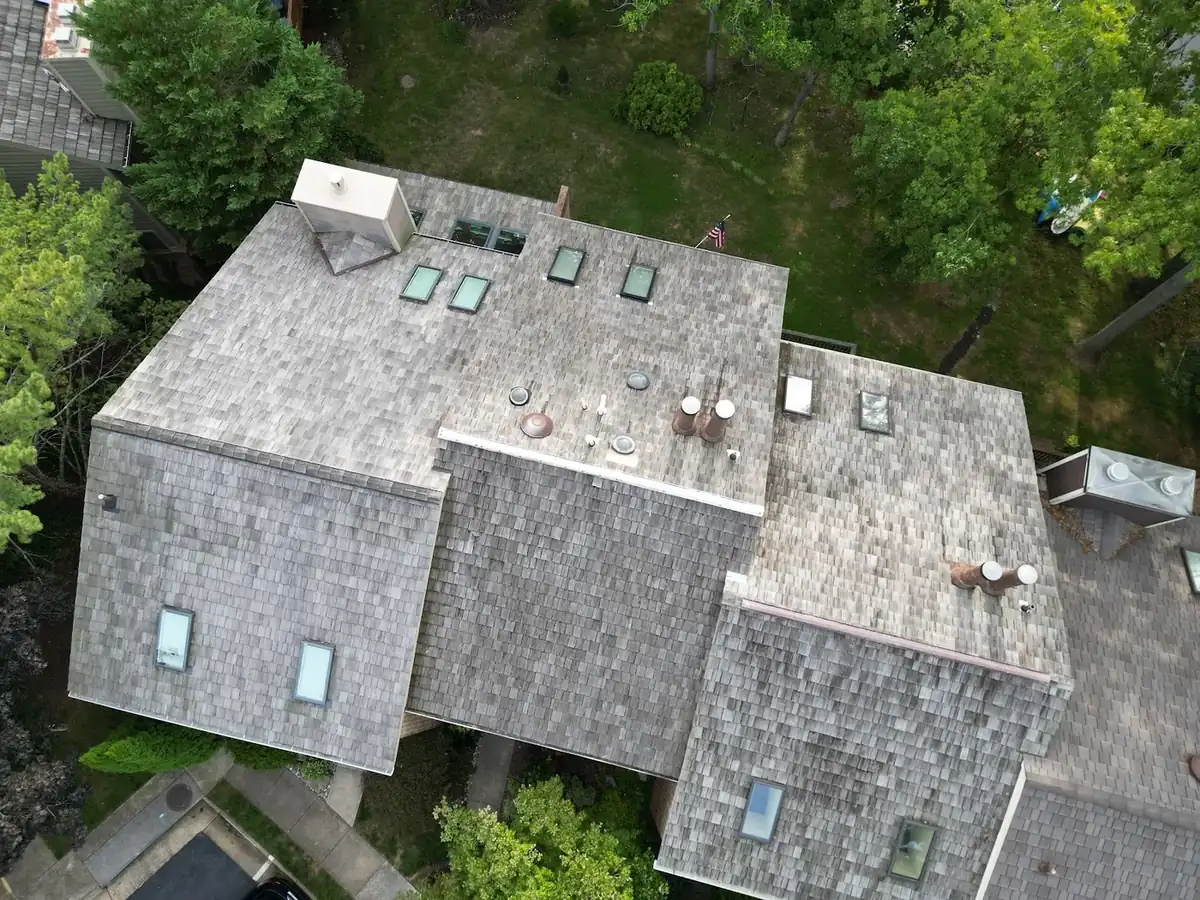
Chimney flashing, plumbing boots and lifted shingles are the usual sources on older roofs. See roof repair for how a leak is traced.
When wear is spread across the roof, a written scope for roof replacement is easier to compare than a string of patches.
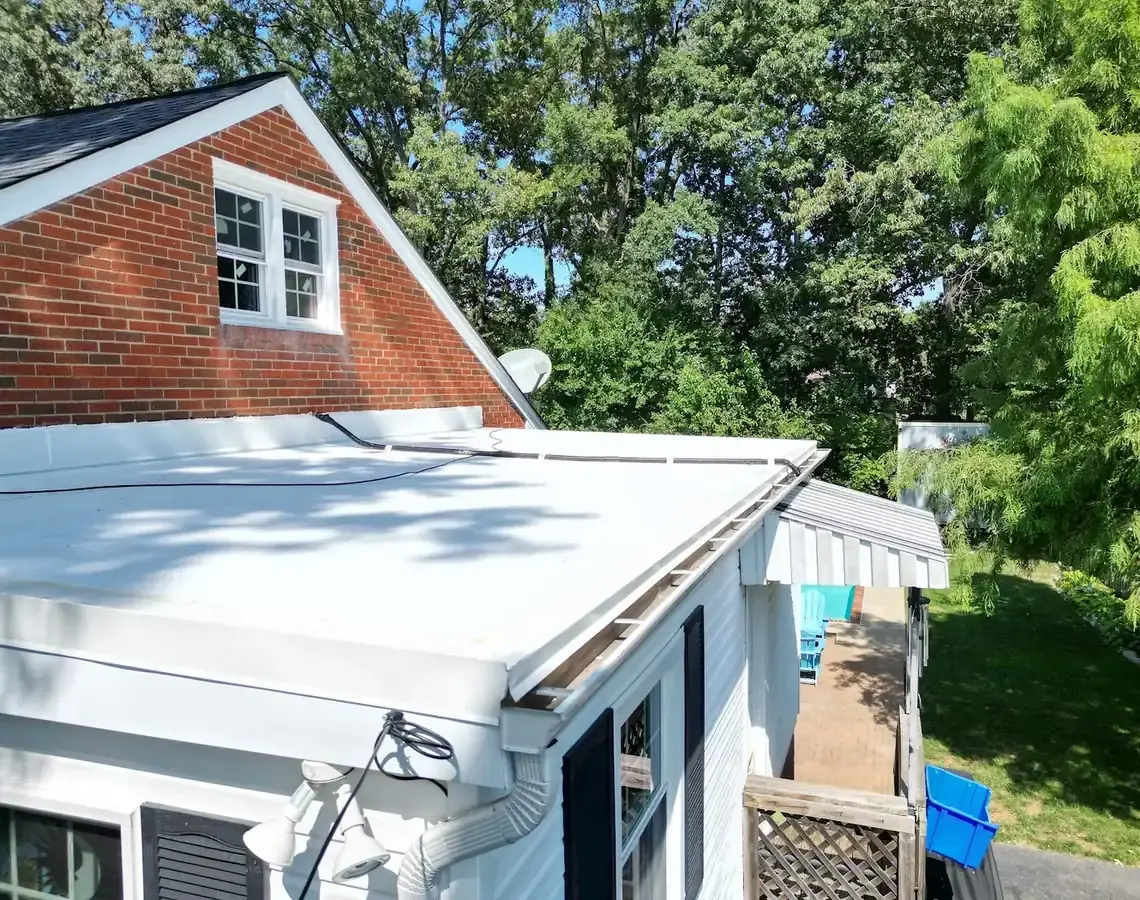
Rear additions, porches and apartment-building roofs use membranes, covered under flat roof work. Compare surfaces on roofing materials.
Permits
Always confirm with the office. We do not tell anyone that a permit is never needed.
| What you plan | Inside the City of Fairfax | Fairfax County address |
|---|---|---|
| Shingle replacement | Code Administration, (703) 385-7830; confirm with the office | The county lists replacement of roof shingles as work that does not need a building permit; LDS, 703-222-0801 |
| Roof repair, chimney repair | Code Administration; confirm with the office | The county lists roof repairs and chimney repairs as permit work |
| Decking replacement | Code Administration; confirm with the office | Under 256 square feet of roof plywood is listed as no permit, unless fire rated, such as townhomes |
| Solar panels on the roof | Code Administration | Listed by the county as permit work |
| Different material seen from the street | City Community Development and Planning, for the overlay districts below | Your own association, if you have one |
The City page says applications and plans must follow the 2021 Virginia Uniform Statewide Building Code starting January 18, 2025, and that construction codes are set by the state and cannot be changed by local governments. The statewide code exempts many residential roof-covering replacements and decking of 256 square feet or less, with exceptions for fire-rated decking and wind zones, and the City’s permit questions page does not spell out roofs. That is why we ask Code Administration about your exact scope before work is scheduled.
Old Town overlays
Inside the City, the Historic Overlay District is a local zoning layer. The City’s own FAQ says physical changes to properties in it that are visible from the street or other public places are subject to architectural review by the Board of Architectural Review. The City’s zoning code names three such districts, Old Town Fairfax, Fairfax Public School and Blenheim, plus an Old Town transition overlay with a similar certificate rule for visible exterior material changes. Boundaries differ from the National Register district, so check your parcel.
The FAQ also says National Register listing on its own has no effect on what an owner can do. In practice, replacing a roof with the same material and color is a different conversation from switching to metal on a street-facing slope. Ask the City’s Community Development and Planning department with your address and the product in hand, before anything is ordered.
Apartments and additions
About 26.4 percent of City homes, 2,456 of 9,313 units by our count of the Census table, sit in buildings of five or more units. Roofs on those buildings are usually low-slope membranes, and the same goes for many porch roofs and rear additions on houses. Typical surfaces are TPO and PVC, which are welded white or light sheets, EPDM, a black rubber sheet, and modified bitumen.
For an apartment or condo roof, the first question is who owns it: the board or management, not the unit owner. For a house addition, the first question is drainage, since a low-slope surface sheds water slowly. If you see standing water two days after rain, or a stain under a flat section, describe it on the phone. More detail is on our flat roof page.
Visible roof material
Standing seam and metal shingle roofs are common choices, and in Fairfax the deciding question is where the house stands. Outside the overlays, a metal roof is a product and flashing decision. Inside Old Town and the other City overlays, a change of material visible from public places is the kind of change the Board of Architectural Review looks at, so the answer comes from the City before the order does.
Metal also brings details worth putting in the scope: how snow and ice move off the roof, how the panels are fastened, and how skylights and chimneys are flashed. See roofing materials for how it compares with shingles.
Housing stock
Census Bureau 2020 to 2024 estimates describe the Census’s count of homes, not roofs, so roof age and material still have to be checked on site.
5,345 units, or 57.4 percent, were built before 1970 by our sum of the decade counts. Only 31 date from 1939 or earlier, so Old Town houses are a small share of jobs.
5,061 detached houses, 1,587 townhouse-type attached homes (17.0 percent) and 209 units in two-to-four-unit buildings.
Of 9,155 occupied homes, 6,399 are lived in by their owners, which is 69.9 percent, so most roof decisions are made by the household.
Attached homes matter because the county’s list excludes roof plywood that must be fire rated, such as on townhomes, so ask the right office before decking is torn out.
Weather and trees
FFXnow reported that the overnight storm of September 3 to 4, 2026 brought gusts above 60 mph to the D.C. region. As of 10 a.m., about 607 Dominion customers in Fairfax City were without power, against 16,464 in the county. The article describes outages and fallen trees, not roof damage in the City.
After wind, look from the ground for lifted shingles, bent flashing and limbs resting on the roof. If a tree is on the house, stay off the roof and call. Check removal rules with the City before anything is cut.
Streets
Route 236 is called Main Street inside the City and Little River Turnpike in the county. Route 123 passes the Historic Fairfax County Courthouse as Chain Bridge Road. A street name alone is not a boundary, so we check the parcel.
How a job starts
We ask for it first, then place it in the City or the county.
Where water shows, what the roof is made of and how old it seems.
Someone checks the surface, flashing and what can be seen of the deck.
Materials, exclusions, and who confirms permit or overlay questions.
Done to the scope, with the work area left clean.
Reviews
5.0 on Google from 60 reviews.
FAQ
No. The County Government Center and its Land Development Services office are in unincorporated Fairfax County. A roof there goes to the county, not to City Hall on Armstrong Street.
The City’s Code Administration page lists (703) 385-7830. For county addresses the county page lists 703-222-0801. Confirm with the office that matches your parcel.
The City says applications and plans follow the 2021 Virginia code from January 18, 2025. We write the scope to that code and confirm the permit question with the office.
It depends on the parcel. A change of material seen from the street inside a Historic Overlay District is subject to architectural review, so ask the City’s Community Development and Planning department first.
The City’s FAQ says listing alone does not affect what you can do with your property. The local overlay is the part that reviews visible changes.
No. Only 31 of 9,313 City units were built in 1939 or earlier, and the median year built is 1967, so most roofs sit on mid-century houses and townhouses.
About 26.4 percent of City homes are in buildings of five or more units, and those roofs are normally a building matter for the owner, board or manager. Start with them, then call us with the roof details.
No. The September 2026 report counted power outages and fallen trees, not roofs. Inspect from the ground and call if you see missing shingles or a leak.
Nearby
Fairfax borders communities with their own pages: Oakton, Burke, Annandale, Vienna and Falls Church. See every place on service areas or read about King’s Roofing.
Checked October 8, 2026: City of Fairfax Code Administration, Fairfax County when a permit is required, City historic district FAQs, FFXnow storm report.
Talk through the next step
Give us your street address and what the roof is doing. A short phone call sorts out the City or county question before anyone is scheduled.