Roof repair
Leaks at party walls and chimneys. See roof repair.
Only three kinds of Alexandria property answer to a Board of Architectural Review: the Old and Historic Alexandria District, the Parker-Gray District and designated One Hundred Year Old Buildings. In those, replacing 25 square feet or more of roofing that the street can see goes to BAR staff, while flat and low-slope roofs are not reviewed by the Board. And some "Alexandria" mailing addresses belong to Fairfax County.
The visibility test
The City's roofing sheet, amended July 16, 2025, sorts work into three levels. Repair or in-kind replacement of less than 25 square feet needs no BAR review, and neither does work on snow guards, leaf guards, gutters or downspouts. Appropriate replacement of 25 square feet or more goes to staff. The Board itself only sees a project that staff refers to it.
Visibility is the trigger, and it is judged on site. The administrative policy says BAR staff visit the property to decide whether the work can be seen from a public right-of-way. If staff believe historic material can reasonably be repaired, they will not approve its removal administratively.
The City says the Old and Historic District, established in 1946, generally runs from Hunting Creek north to Bashford Lane and from the Potomac River to near the King Street Metro. Its boundaries differ from the National Register's, so use the City's map viewer.
What we do here
Leaks at party walls and chimneys. See roof repair.
Tear-offs planned around your street's review level. See roof replacement and the materials guide.
Membrane roofs over apartment buildings and additions. See flat roof.
City offices
Details below come from City pages read on October 9, 2026. Confirm your scope with the office before work is scheduled.
The Permit Center sits on the second floor of the Redella S. "Dell" Pepper Community Center. Its page asks customers to submit applications only through APEX, the City's online permitting system, and lists Permit.Center@alexandriava.gov and 703.746.4200 for help. The counter closes at 2 p.m. on the first Monday of every month.
The page also warns of scammers posing as City officials; it says the City never asks for permit fees by cryptocurrency, wire transfer, Venmo or Zelle.
| What you plan | Who to ask | Contact on the office's page |
|---|---|---|
| Roof work on any parcel inside the City | Code Administration, Permit Center | 703.746.4200, Permit.Center@alexandriava.gov |
| Visible roofing in Old Town or Uptown | Historic Preservation staff, Planning and Zoning | 703.746.3833, preservation@alexandriava.gov |
| Not sure the house is in a district | The City's Historic Preservation map viewer, then staff | 703.746.3833 |
| Apartment or condominium roof | Your association or building owner, then the Permit Center | Ask for the roofing rule in writing |
| Alexandria address inside Fairfax County | Fairfax County Land Development Services | 703-222-0801 (TTY 711) |
The address trap
Not always. The City's tax guide says 22301, 22305, 22313 and 22314 lie entirely inside the City. The 22302, 22304, 22311 and 22312 ZIP codes are shared with Fairfax County, and 22206 is shared with Arlington County. The guide tells residents of the shared ZIPs to verify their locality through the Postal Service lookup.
The parcel, not the mailing city, decides the building office, and the BAR exists only on the City side. We check this on the first call.
Matching what is there
The City's published policy, amended September 24, 2025, says to match the original. Original slate or tile is replaced with the same material, style, color and shape. Original metal is replaced with the same style: standing seam, flat seam or stamped shingle. Solid copper may replace painted standing seam.
Original composition shingle may be replaced with architectural grade shingle, but three-tab is not appropriate unless it was the original. No product is pre-approved by name.
One more line on the City's districts page: the Board approves a Permit to Demolish for removing more than 25 square feet of material on a structure, visible or not. We ask staff how that applies to a roof tear-off.
Historic but not regulated
No. The City's historic districts guide lists seven districts and says only Old and Historic Alexandria and Parker-Gray are regulated; no approval from a City architectural review board is needed for changes in the others.
The state register describes Rosemont as more than 450 residences developed from 1908 to 1914, and the Town of Potomac district, home of Del Ray, as annexed by Alexandria in 1930.
Low-slope roofs
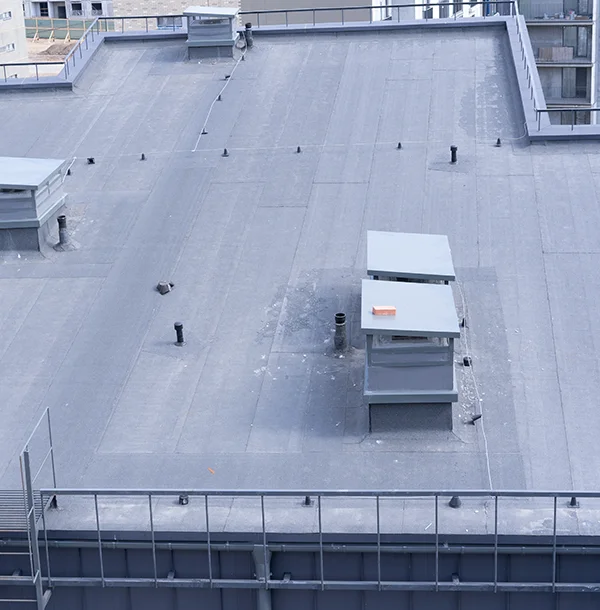
The City's roofing sheets for both historic districts say flat and low-sloped roofs, because of their limited visibility, are not reviewed by the Board. The BAR drops out of the material choice, but permits still run through Code Administration.
TPO is a single-ply membrane with hot-air welded seams, suited to a large, nearly flat deck over an apartment building or rear addition.
The Board's sheet recommends light colors on flat roofs to reduce air conditioning loads and the urban heat island effect. See our flat roof page for membrane repair and replacement.
Condominiums and apartments
Virginia's Condominium Act defines common elements as all portions of the condominium other than the units. Whether a roof is one depends on the building's condominium instruments.
Housing
Census Bureau figures, ACS 2024 5-year estimate for the City of Alexandria, 80,844 homes.
11,237 single-family houses.
16,825 rowhouses and townhouses.
49,255 homes, computed from the Census size bands.
The median Alexandria home was built in 1974, and 43.2 percent were built before 1970. Of 76,096 occupied homes, 42.1 percent are owner-occupied. The Census counts homes, not roofs, so none of this says anything about one roof's age, shape or material.
Weather and trees
ALXnow reported on September 4, 2026 that outages peaked above 10,000, including 16 special customers. At least five people were rescued from floodwater near Slaters Lane, and a downed tree in the 700 block of N. Columbus Street was blocking several homes. The report describes outages, trees and flooding, not roof damage.
Process
The parcel picks the office.
Free 15 minutes on the roof and its street view.
Staff, the Board or neither.
Materials, exclusions, City paperwork.
Reviews precede a crew date.
Reviews
5.0 on Google from 60 reviews.
FAQ
The City's sheet lists repair or in-kind replacement of less than 25 square feet as needing no BAR review. Call 703.746.3833 to confirm.
The City's policy says original slate or tile must be replaced with the same material, style, color and shape. Ask staff before ordering anything.
The City's guide says no approval from a City architectural review board is needed in the districts other than Old and Historic Alexandria and Parker-Gray. Del Ray's district, Town of Potomac, is one of those.
The policy says three-tab is not appropriate unless it was the original roofing.
The roofing sheets say flat and low-sloped roofs, due to their limited visibility, are not reviewed by the Board.
22304 is shared between the City and Fairfax County, so the parcel decides. The City's tax guide points residents to the Postal Service lookup.
Nearby
Alexandria touches Arlington and Fairfax County, and we also work in Springfield, Washington DC and Falls Church. See every place on the service areas page, read about King's Roofing.
Official pages used, checked 2026-10-09: City of Alexandria Permit Center, BAR roofing sheet, Old and Historic District, BAR roofing sheet, Parker-Gray District, BAR Policies for Administrative Approval, City historic districts page, City tax guide for new residents, Fairfax County Land Development Services.
Roof material guides for Alexandria: TPO roofs in Alexandria, metal roofs in Alexandria, EPDM roofs in Alexandria, PVC roofs in Alexandria.
Talk through the next step
Share the address, what you are seeing on the roof and the decision you need to make. We will tell you what to expect before anything is scheduled.
9220 Topaz St, Fairfax, VA 22031
Mon to Fri 7 AM to 8:30 PM, Sat 7 AM to 8 PM, closed Sunday