EPDM roofs in Leesburg, VA: whose decision is the roof?
No Town or county page we read mentions EPDM. What separates one Leesburg owner from the next is simpler: whether you hold the roof yourself, share it with a neighbour, or rent under somebody else's.
EPDM is a rubber sheet for low-slope roofs, so it comes up only where a Leesburg building has one. Who orders it depends on the building: an owner of a detached house, an owner who shares walls, or a landlord or board.
- Renters hold most of the larger-building homes
- Shared walls bring a neighbour into the decision
- A detached house is rarely an EPDM question
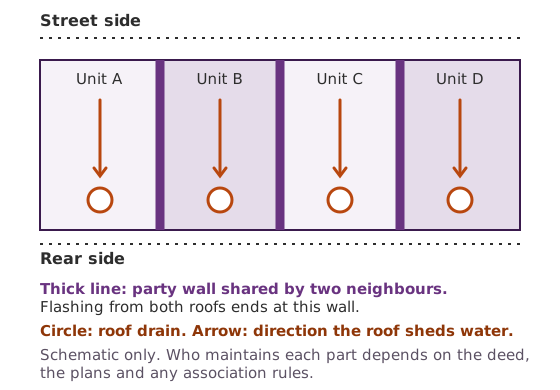
A row of attached roofs
Why is a shared wall a different question from a rubber sheet?
EPDM is a thermoset rubber single-ply, one of the sheet types in the building code's single-ply table. Its overlaps are joined with tape or adhesive rather than welded with heat. An NRCA library abstract from 1991 says many EPDM problems involved those lap seams; it predates current products, so we use it as a reason to ask how seams are made and checked, not as a verdict.
In a row like this one, the same questions meet the shared walls: whose drain takes the water, and who maintains each edge. The plan is a schematic. It is not a statement of what any code requires of your row.
Census, tenure by building size, ACS 2024 5-year
The Census counts occupied homes by who lives in them and by how many units share the building. It does not count roofs, so each answer below is what the building type tells you about the decision, not about the roof overhead. The Town has 16,660 occupied homes: 11,486 owner-occupied and 5,174 rented.
Buildings of five or more units: a landlord or board chooses
Of the 3,963 occupied homes in buildings of five or more units, 3,187 are rented and 776 are owner-occupied. So in roughly four of every five homes in these buildings, the person living under the roof is not the person who can order one. That person is the landlord, or for the 776 owners, an association, whose own documents set the rule.
Low-slope roofs are where an EPDM sheet would be considered, and the flat roof guide explains how a sheet is laid and where it is joined. A resident who sees a stain can photograph it and pass it up; the decision, and the choice of material, sits with the owner.
Townhouses and other attached homes: the neighbour is part of the roof
Attached homes number 3,721 owner-occupied and 1,247 rented. Their roofs meet at party walls, so a leak at the joint can involve two households and a seam, and a roof plan from the builder or association matters before a material does. Virginia's permit exemption for replacing roof covering is written by building group, and the code text does not say which group a given townhouse belongs to; Loudoun's building office decides that. The Leesburg hub lays out the county and Town counters.
Neither the Town's home improvement page nor Loudoun's permitting page mentions roofs at all. Both do say a homeowners association may impose its own requirements, and Loudoun puts the job of asking on the applicant.
Detached houses: 6,741 owners, 468 renters, and usually another material
Detached homes are the largest block, and about one in 15 of the occupied ones is rented. A rubber membrane comes into a detached house only where part of the roof is low-slope, such as a porch top or a rear addition. A pitched roof overhead is a different question, handled on our materials page.
If the house is inside the Town's Old and Historic District, the metal roofs page reads the Town's roof wording, which concerns pitched materials.
A tenant cannot order the roof
Where a landlord holds the building, a resident's job is to photograph the stain and send it up, and the owner's job is to ask about the roof section by section.
Before the phone call
Who in your building has to say yes first?
- Own or rentRenters pass the stain to the landlord with photographs.
- A shared roofFind the association's roofing rule in writing.
- Which section is low-slopeA porch, an addition or a rear section, not the whole roof.
- Which officeParcel in the Town or the county, and in a district or not.
FAQ
Questions Leesburg renters and owners ask about rubber roofs
Can a Leesburg tenant order a new EPDM roof?
Not alone. The Census shows 3,187 rented homes in buildings of five or more units, and in those the owner holds the roof. A tenant can document the problem and send it up.
Does the Town of Leesburg have a page on EPDM?
None that we found. The pages we read cover zoning, certificates and the Old and Historic District, and none names EPDM. We checked the Town's home improvement page through an archived copy.
Do Loudoun's permit pages say anything about roof materials?
The permitting page we opened on October 14, 2026 says the county issues building permits countywide and puts HOA approvals on the applicant. It names no roof material.
Does a shared roof wall change who pays for the roof?
It can, depending on your deed and your plans. We do not assume; ask the association for the roofing rule in writing.
Keep reading
The Leesburg roofing page covers the county and Town split. For how rubber and other single-ply roofs differ, see the flat roof guide and the Northern Virginia single-ply guide. One Town document sorts "rubber membrane" by whether a flat roof can be seen from the street; the TPO roofs page reads it, and no document says whether the phrase means EPDM. The metal roofs page reads the Town's pitched-roof wording. Nearby, EPDM in Ashburn and EPDM in Sterling read their own local sources.
Sources, checked October 14, 2026. Census Reporter, ACS 2024 5-year, tables B25003 and B25032, Loudoun County, Permitting, Virginia Administrative Code, 13VAC5-63-80, Town of Leesburg, Home Improvement Projects (the Town's server blocked automated reading, so an archived copy was used), NRCA library, EPDM lap seam abstract and thermoplastic versus thermoset abstract (opened October 11, 2026).
Talk through the next step
Talk through your roof with King's Roofing
Share the address, what you are seeing on the roof and the decision you need to make. We will tell you what to expect before anything is scheduled.
9220 Topaz St, Fairfax, VA 22031
Mon to Fri 7 AM to 8:30 PM, Sat 7 AM to 8 PM, closed Sunday