Buildings of five or more units
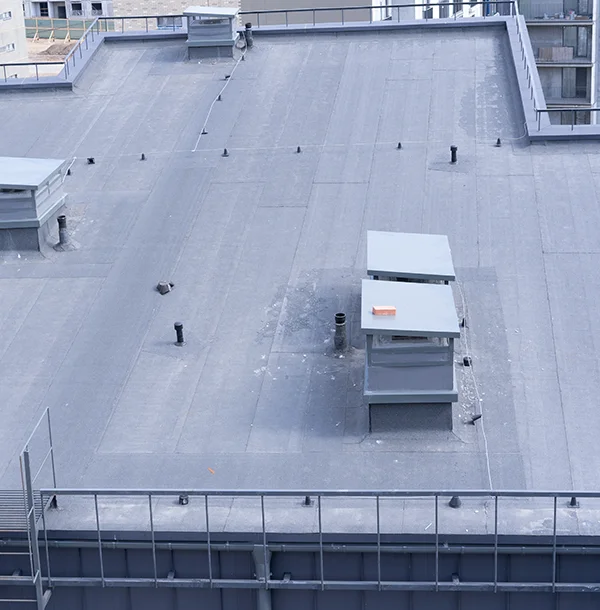
Of 361,014 housing units, 56.9 percent are in buildings of five or more units and 10.2 percent in buildings of two to four. Roofs over those are shared, and the owner is often an association or a landlord.
In DC the flat roof is the normal roof. The District's own Office of Planning says most rowhouses have flat roofs, and more than half of the city's homes sit in buildings of five or more units. This page covers the membranes those roofs use, TPO, EPDM and PVC, and what actually draws review in a historic block.
The wedge
Usually the surface itself is not the issue. The Office of Planning's roof guideline says a flat roof is typically not visible from the ground, so its design does not normally add to the character of a building, and it lists built-up and rubber roofing among coverings that are usually not character defining. What it calls almost always visible is the edge: the cornice, the parapet, the pent roof.
HPO's list of minor work that qualifies for expedited review names roofing and coping under in-kind or compatible repairs. If the work is compatible and consistent with HPRB standards, HPO can clear it, and if not, it goes to the Review Board. So the practical question for a membrane job is what happens at the parapet, coping and flashing, not only the sheet.
Jurisdiction, permit offices and the full rule set are on our Washington, DC roofing page.
Housing
Census numbers describe homes, not roofs. They come from the American Community Survey 2024 five-year estimates for the District.
Of 361,014 housing units, 56.9 percent are in buildings of five or more units and 10.2 percent in buildings of two to four. Roofs over those are shared, and the owner is often an association or a landlord.
Single-unit attached homes, most of them rowhouses, are 21.7 percent of units, and detached houses 11.0 percent.
The median build year is 1958 and 31.5 percent of units date from 1939 or earlier. Renters occupy 58.5 percent of occupied homes, so the person calling about a leak is often not the roof's owner.
TPO
TPO is a single-ply thermoplastic sheet, usually white or light gray. The laps are joined with hot-air welds, and walls, drains and vents get matching flashing pieces.
On a block where the roof is hemmed in by party walls and taller neighbors, a light surface sheds heat and the welded laps leave few exposed edges.
Switching from a dark membrane to a white one changes appearance, which is the test in DC's code for in-kind replacement. In a historic district, raise it with HPO before ordering.
EPDM
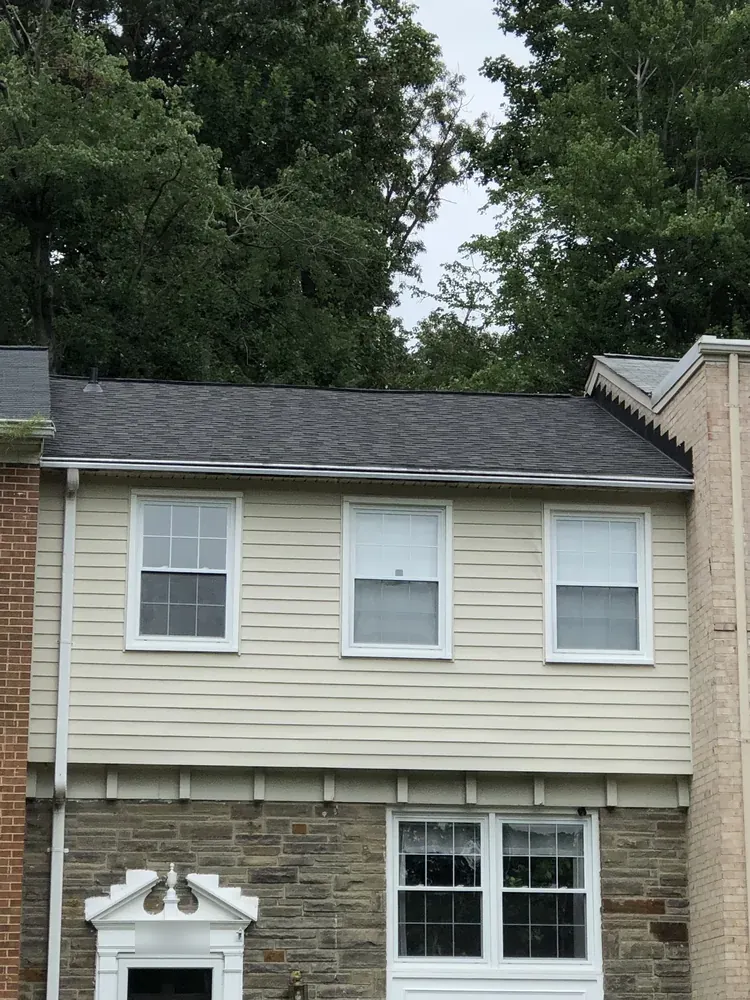
EPDM is the black synthetic rubber sheet that many older DC rowhouse roofs already wear. Repairs are often local: a lifted seam, a cracked corner at a wall, a pipe boot, a drain bowl that no longer seals.
The District's roof guideline notes that flat roofs usually slope toward the rear of the building to drain water. That is why leaks on a rowhouse so often show at the back: water follows the fall, collects at the rear scupper or drain, and finds the weakest flashing along the way.
Where the membrane is sound and only the edges have failed, repair the edges. Where seams lift across the field, or the sheet has hardened and split, patching stops being enough.
PVC
PVC looks like TPO and is also hot-air welded. It earns its place on roofs that take grease from restaurant exhaust or chemical residue, which is why it appears over DC's ground-floor retail with apartments above. For an ordinary rowhouse deck, TPO or EPDM usually does the same job. Ask about PVC when a vent, hood or equipment curb sits on the roof, and see our flat roof page for the side-by-side comparison. Metal is covered under metal roofing.
Rules
Confirm your own scope with the offices before work is scheduled. Pages checked October 9, 2026.
| What you plan | What the page says | Who to ask |
|---|---|---|
| Same membrane, same look | Section 105.2 of the DC building code exempts replacement in kind of roof covering or coping, meaning like material that replicates the existing feature in proportion, appearance, texture, design, detail and dimensions | Department of Buildings (DOB) |
| Same membrane in a historic district | DOB's Historic Property Special Permit lists replacement in kind of roofing and coping and asks you to confirm with the Office of Planning before submitting | Historic Preservation Office, 202-442-7600 |
| Parapet, coping or cornice work visible from the street | HPO can clear compatible work, and incompatible work goes to the Historic Preservation Review Board | Historic Preservation Office |
One number applies to all four membrane families in the same way. The code text asks for a design slope of not less than one-fourth unit vertical in 12 horizontal, a 2 percent fall, for built-up, modified bitumen, thermoset and thermoplastic single-ply roofs.
Shared roofs
On an attached block the party wall carries the parapet and coping for two roofs at once, and a rear drain line may serve more than one. Before a repair, find out which side owns the wall cap, where the water leaves, and whether a neighbor's roof drains onto yours. For condominiums and co-ops, ask the board before ordering materials.
Our TPO, EPDM and modified bitumen guide and the notes on commercial flat roofs in DC go further on each membrane.
Phone call
Rowhouse, condominium, or small apartment building, and who owns the roof.
Where water shows inside, and whether it appears after rain or snowmelt.
The parapet, coping and any pent roof, and whether the block is in a historic district.
Reviews
5.0 on Google from 60 reviews.
FAQ
Rarely perfectly. The Office of Planning's guideline says flat roofs usually slope toward the rear of the building to drain water, and the code asks for a fall of one-fourth inch in 12 for membrane roofs.
It is a change of appearance, so it falls outside the code's like-for-like wording. In a historic district, ask HPO first. Elsewhere, ask the Department of Buildings.
Water travels along the fall, and the roof drains toward the rear. Check the rear drain, the parapet cap and the wall flashing before the field of the roof.
The guideline calls flat-roof coverings usually not character defining, and says the cornice, parapet and pent roof at the edge are almost always visible. Review tends to focus on those edges.
The Department of Buildings handles permits. The Historic Preservation Office, part of the Office of Planning, reviews work on historic property and staffs the Review Board. Details sit on our DC roofing page.
Mostly when a kitchen exhaust or similar equipment sits on the roof. For a plain rowhouse deck, TPO or EPDM usually covers the need.
Nearby
Across the river the rules change, so those pages stand apart: Arlington and Alexandria. In Maryland see Bethesda and Silver Spring. Browse all service areas, or read about King's Roofing.
Talk through the next step
Tell us the building type, where water shows inside and what the roof surface looks like. We will talk through repair or replacement on a short phone call.
9220 Topaz St, Fairfax, VA 22031
Mon to Fri 7 AM to 8:30 PM, Sat 7 AM to 8 PM, closed Sunday