Storm damage roof repair in Northern Virginia: what the record and the rules say
After a storm, the useful questions are what you can see from the ground, who needs to be told, and whether the repair needs a permit. Each answer below rests on a named source opened on October 16, 2026.
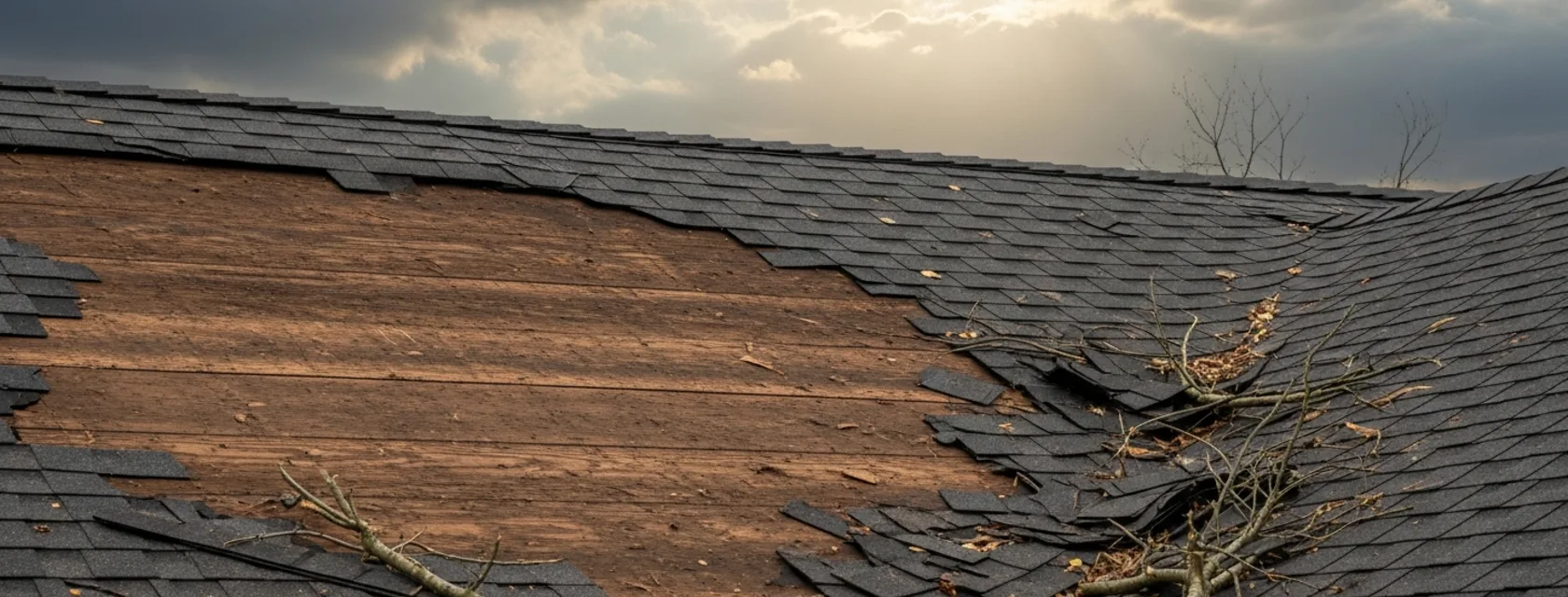
Stay safe, document, tell your insurer, then get a written look at the roof
That order comes from the Insurance Institute for Business & Home Safety (IBHS). Whether a repair needs a permit is a separate question, and the Virginia rule, the county pages and your association each answer part of it.
What NOAA lists
Four counties, nearly twelve years of storm reports, and what they leave out
NOAA's Storm Events Database holds county-level reports from spotters, officials and the public. We counted entries for Fairfax, Loudoun, Prince William and Arlington counties from January 2015 through September 2026, the last month in the 2026 file. The log lists what was reported, so a quiet stretch does not prove a quiet sky.
| Hazard in the log | Entries | What the entries record |
|---|---|---|
| Thunderstorm wind | 1,012 on 225 dates | Gusts of 35 to 78 knots (units are knots, per NOAA's format guide); 981 entries at 50 knots or more |
| Hail | 142 on 44 dates | Sizes 0.75 to 3.00 inches; 135 entries at 1.00 inch or larger |
| Tornado | 12 | Fairfax 5, Loudoun 4, Arlington 2, Prince William 1 |
| Flood and flash flood | 677 | Water on the ground and in streams, which is a different problem from water on a roof |
The log is not a roof survey. Of 1,847 entries across the four counties, 21 use the word roof or shingle in the narrative. One, from Loudoun on July 21, 2019, reads “Roof damage occurred to a home in the 39000 block of Meadowlark Drive near Irene Drive.” Another, from Arlington on September 1, 2021, describes a large limb blowing through a residence's roof. A hailstorm or wind event in your neighborhood may never appear in it.
For town-level entries and what each hazard asks of a low-slope roof, see our storm-record pages for Herndon, Woodbridge and Burke, or the hubs for Fairfax, Arlington and Leesburg.
What you can check without a ladder
Three places storm damage shows up before anyone climbs
Shingle pieces in the yard
- What you see
- Missing shingles on the roof or shingle debris in the yard.
- What it can mean
- IBHS notes the debris could come from your roof or a neighbor's, so the roof itself still needs a look.
- Who to call
- A roofer for a written inspection.
Stains and damp in the house
- What you see
- Water spots or stains on a ceiling; water or standing water in the attic.
- What it can mean
- IBHS lists both as signs to check. They show that water got in, not where or why.
- Who to call
- Your insurer to report the loss, and a roofer to find the opening.
Dents after hail
- What you see
- Dents in gutters, HVAC units or downspouts, then siding and windowsills.
- What it can mean
- IBHS points to these after a hailstorm. They show hail fell at the address, and they do not measure roof damage.
- Who to call
- Your insurer, with photos taken before any cleanup.
IBHS, After Severe Weather
The order of the first steps
- 1. Protect people
Check that everyone is safe, and treat downed power lines as live. IBHS says not to enter a damaged building unless local officials say it is safe.
- 2. Document
Take photos and videos of what is damaged, then look at ceilings and the attic.
- 3. Tell your insurer
IBHS lists the policy number, type and date of loss, a description and a home inventory as what to have ready.
- 4. Keep receipts
Keep records for added expenses. Ask your insurer which ones it reimburses; the sources here do not say.
- 5. Limit further damage
IBHS suggests a reputable roofer to tarp the roof while repairs wait.
Hire a reputable roofer to tarp your damaged roof, while waiting for your roof to be repaired.
IBHS, After Severe Weather, step 5, ibhs.org/thunderstormreadyhomeafterevent, checked October 16, 2026.
Permit pages opened October 16, 2026
Does a storm repair need a permit, and who else has to agree?
Virginia's rule, 13VAC5-63-80, says a permit is not required for replacing 100 square feet or less of roof covering in all groups and wind zones, with a wider allowance for one-to-three-family housing groups R-3, R-4 and R-5 outside areas above a 100 mph design wind speed. It adds that this does not exempt work from other code requirements, and that a building official may require a permit in a local historic district or a special flood hazard area.
| Page | What it says about roof work | Where it stops |
|---|---|---|
| Fairfax County, Land Development Services | Lists replacement of roof shingles, and less than 256 square feet of roof plywood, among work that needs no permit. | Plywood that must be fire rated, such as on townhomes, is carved out. |
| Prince William County, Building Development | Lists re-roofing and replacing 256 square feet or less of roof decking among work that needs no permit. | Fire-retardant decking needs a permit. The page also says HOA covenants may require approval for roofing, and that zoning approval may apply whether or not a building permit does. |
| Loudoun County, Permitting | Does not mention roofs. It says county approval does not replace approval from an incorporated town. | It puts HOA and POA contact on the applicant. Ask the county and your town. |
An exemption from a permit is not an exemption from the code, and it does not speak for an association. For the work itself, see our pages on roof repair and roof replacement.
Before anyone signs anything
What a written storm inspection should name
IBHS publishes a roof inspection list, and a report that follows it can be compared line by line with the photos you took.
- Roof coverAsphalt shingles curled, loose (unsealed), missing or torn; tiles cracked or unattached; metal panels dented, with loose screws, worn washers, worn paint or rust.
- Vents and skylightsLoose seals on vents; leaking, loose or wavy flashing and cracks around skylights.
- ChimneysLeaking around the flashing and missing mortar.
- Valleys and seamsLeaks from valleys or seams under the roof cover.
- Flat roofsSPRI says low slope roofs should be inspected after any major storm, with attention to flashings around penetrations and to open drains. See our flat roof guide.
- The repair methodARMA describes repair as replacing shingles punctured by windborne debris or resealing shingles damaged by high winds. Ask which of these the scope calls for.
ARMA adds that new shingles may look different at first because they have not aged like the rest of the roof, and that knowing the color name and the year of installation helps with a match. If the scope points toward a new roof instead, our materials guide and service areas are the next pages to read.
Questions after a storm
Should I get on the roof to look after a storm?
IBHS's steps start with safety and with checking the ceiling, the attic and the yard for shingle debris. They do not ask the owner to climb up. A roofer's written inspection covers the roof itself.
Will NOAA's storm log show whether my street was hit?
Not reliably. The database is built from reports, and only 21 of 1,847 entries in four Northern Virginia counties mention a roof or shingles. Your photos and a written inspection are the record for your roof.
How do I tell hail from wind damage?
IBHS points to dents in gutters, HVAC units and downspouts after a hailstorm, and to missing shingles or shingle debris after wind. Neither sign replaces an inspection on the roof.
Can a tarp go on before my insurer visits?
IBHS suggests having a reputable roofer tarp a damaged roof while waiting for repairs. Ask your insurer whether it wants to see the roof first and how it treats a temporary cover.
Does replacing a few shingles after a storm need a permit?
Fairfax County and Prince William County list shingle replacement or re-roofing among work that needs no permit, and Virginia's rule exempts 100 square feet or less of roof covering. Rules in a town, a historic district or an association can add steps.
Does my homeowners association have to approve a storm repair?
Prince William County and Loudoun County both tell owners to contact their association about its own requirements. Read your covenants or ask the association.
Are flat roofs checked differently after a storm?
SPRI's guidance for low slope roofs names flashings around penetrations, loose metal and fasteners, and open drains. Our flat roof guide covers the membrane types.
Can a storm repair be made to blend with the existing shingles?
ARMA says new shingles may look different at first, and that the color name and installation year help a contractor find a close match. Keep any leftover shingles you were given.
Sources opened for this guide on October 16, 2026
- NOAAStorm Events Database detail files, 2015 to September 2026 and its format guide.
- IBHSAfter Severe Weather and the Thunderstorm Ready roof inspection list.
- ARMA and SPRIAsphalt Shingle Roofs are Repairable; SPRI frequently asked questions.
- Virginia13VAC5-63-80.
- CountiesFairfax County, Prince William County and Loudoun County permit pages.
The Arlington County permit pages blocked our request, so none of this guide rests on them. Insurance terms are for your policy and your insurer to answer.
Talk through the next step
Tell us what you see on the roof
Give us the address, the date of the storm and what you can see from the ground or from inside the house. We will tell you what a written inspection should cover and which office to ask about a permit.
9220 Topaz St, Fairfax, VA 22031
Mon to Fri 7 AM to 8:30 PM, Sat 7 AM to 8 PM, closed Sunday